
Category Archives: VC

Six Tips on Presenting to the Board of Directors

So, you’re on the executive staff of a startup and you’ve been asked to present at an upcoming board meeting.  That’s great news. Board exposure is a key benefit of working on the e-staff. You’re getting the chance to build relationships with the venture capitalists and independent directors who sit on your board. These people can help you in many ways, e.g., providing tactical advice, acting more generally as mentors, helping you extend your network, approving your future promotion to a more important position, presenting you with outside board or advisory opportunities, and — when the time comes for it — helping you find your next company.

The board can be a tailwind accelerating your career or a headwind slowing it down. Let’s talk today about how to make a good impression in board meetings and how to start building good relationships with the members of your board.

Here are six tips:

  1. Lose the baggage. If you have authority issues or PTSD from prior board experiences, you need to lose the baggage. That may not be easy — and you may need a therapist to do it — but boards can easily sense passive aggression and inauthentic interactions. I worked with one CRO who viewed board meetings as a necessary evil, something to survive so we can all get back to work. If you feel this way, the odds are the board can tell. (Our board certainly could, and it limited his tenure as a result.)
  2. Make your presentation from scratch. Bad board sessions start with bad slides. Usually, they’re too long and detailed. This typically positions the exec as either “in the weeds” (ergo too junior and in need of an upgrade) or “stonewalling” (i.e., deliberately making an overwhelming deck to stifle conversation). The path to hell begins in the slide sorter, so do not start there. Start with a blank outline to avoid the number one mistake — starting with what you have instead of what the audience needs. Doing so is a false economy and, for chrissake, it’s your board: if anyone deserves a custom presentation, it’s them. So make a custom slides, from scratch.
  3. Cut to the chase. Boards are notoriously impatient. Individual sessions are usually pretty short. There’s no time to warm up with “How ’bout those Yankees?” or several introductory slides, including the tired highlights / lowlights slide. (That slide is appropriate once in a board deck, in the CEO’s update, and if there’s something particularly good or bad in a functional area, it should have already been raised there.) If we’ve had insufficient pipeline for the past two quarters, go immediately to the reasons why and the remediation plan. If you’re not sure what the hot issues are — itself a yellow flag — ask the CEO. Nothing will infuriate a board more than endless warm-up slides that don’t cover the important issues. Beware saying: “Great question, but we’ll get to that on slide 27.” With some boards, you may not still be employed by slide 27.
  4. Make slides that facilitate discussion. Board members like to talk, so let them. Build slides that facilitate a discussion. That usually means first baselining the board with key facts and metrics. (Remember, they might sit on 5 to 10 other boards, so they’re not going to remember everything you talked about last meeting.) Then tee-up a discussion using techniques such as: (i) making a proposal and asking for feedback, (ii) outlining three options (if you really can’t decide) and requesting input on them, or (iii) asking three questions that will help you make the decision. Be authentic. Don’t propose three options if two are patently absurd. This wastes the board’s time and they’ll see through it.
  5. ATFQ (answer the effing question). If, at any time during the meeting, the board asks you a question: answer it. Read this — among the top five Kellblog posts of all time — for advice on how to do so. If asked for your opinion, offer it. Don’t stare at the CEO and then toe the company line. The board is fully aware of the disagree-and-commit principle. They assume you’re committed. They’re asking if you agree.
  6. Ask for relevant follow-up meetings. If you’re the CRO and one of your directors is a former-CRO, ask them for an offline meeting to discuss a hot sales-related topic. While you should spend most of that meeting discussing the advertised topic, you should take a bit of time to get to know each other and start building a relationship. Invite them to a coffee if you can, as opposed to a Zoom. Drive to their office if they invite you.

If you follow this advice, you’ll make a better impression on your board than most and you’ll start to leverage board meetings to set up offline conversations that will hopefully lead to a few career-long and career-changing relationships.

As CJ Gustafson replied when we discussed the idea of building relationships, “oh, you could find a relationship like Scorsese and DiCaprio.” Yes, exactly. That worked out pretty well for both of them.

The Paradox of Saying, “It’s Time To Sell The Company”

A critical part of the CEO’s job is realizing when it’s time to sell the company. I’m not talking about the easy cases, like when you’re in year five of running a PE-backed company, and the numbers suggest an exit that produces a 3x+ return. Everyone knows the point was to sell the company one day and that PE generally wants a 3-5x return in 4-6 years. So saying, “it’s time to sell” in this scenario has all the shock value of saying, “it’s six o-clock, I guess I should get started cooking dinner.”

I’m talking about the much more difficult case where the company is performing well financially, but the CEO sees storm clouds on the horizon that indicate the future will quite probably not be as rosy as the past.

Four things combine to make this a difficult conversation:

  • There is no data to suggest the firm is in trouble. In fact, the data suggests quite the opposite, that the future is bright. Think: “You’re on the same trajectory as our best-in-class firms.”
  • The storm clouds are unfavorable trends, not performance problems. But by the time those trends manifest as performance problems, it may well be too late to get a decent valuation for the firm.
  • Your viewpoint will likely be interpreted as self-interested. “What Joe’s really saying is that he wants to cash out.” Or, “Joe’s lost faith in the company because he’s lost confidence in his ability to lead it.” Conclusion: “We need someone running this company who believes in its future and who is capable of taking it to $250M.” Adios Joe. Even though poor old Joe never actually said either of those things.
  • The “hits” nature of the VC business. Selling a winner early can have a devastating impact on the IRR of a fund (e.g., removing the top two performers can change a fund’s IRR from 35% to 12%. Think: “There’s no way we’re taking a double on this investment when I think this can be a home run. I’d rather get thrown out sliding into third.”

The incentives are all wrong. The VCs can’t see the problem in the data because it’s not impacting performance yet. They often don’t want to see the problem because the company may be one of a few winners in the portfolio that they’re hoping will return the fund. It’s very easy for the CEO in this situation to get fired. Think: “If I believed this could be a $1B company despite these storm clouds, then I’d want to fire me, too. But I don’t.”

The ultimate problem is that you can’t see around corners when you’re only looking at performance metrics. Even leading indicators like pipeline won’t be leading enough to show these problems. The best chance of seeing the problem in the data is if a few of your earliest, most visionary customers have moved onto the new thing. But due to switching costs, this doesn’t often happen. Other companies, who skipped your generation of technology, are more likely to be the first adopters of the new, new thing.

For founder/CEOs, recognizing the situation is even more difficult than for hired CEOs because:

  • The founder’s inbuilt reality distortion field. Founders are gifted at willing the world into what they want it to be. This is awesome for driving disruptive visions. It is dangerous when used to imagine away a harsh reality.
  • The “they said we couldn’t get this far” fallacy. Founders have been told so many times by so many people that, “you’ll never be able to do X” that when faced with stated obstacles they immediately rationalize them away. They said we’d never get PMF. They said we’d never get to $1M in ARR. They said the megavendors would crush us. They said we’d never be able to hit $10M. They said we’d never be able to sell enterprise. They said we’d never get to $50M. Most of the time, this obduracy is helpful. Except for the one time when “they” are right.

The are two morals here. First, founders need to try to objectively evaluate facts and disable their knee-jerk, “they said we never could do X” reflex. Second, boards — knowing how difficult it is for a founder to reach the conclusion that they may be in a Kobayashi Maru scenario — should immediately perk up when they hear a founder say that they might be.

To make this concrete, let’s provide a few examples of these storm clouds. I’m not talking about a squall here, I’m talking about clouds that presage a full-blown typhoon:

  • Megavendors entering the category. Worst case, they give away their equivalent of your product to sell their own core product. But even when they sell an entry in your category, they may do so at a lower price. This begs the questions: How much is your differentiation really worth? At what price point can you still compete? How much is your neutrality worth compared to the integrated solution? Examples: Microsoft Power BI, Databricks Unity Catalog.
  • Omission from a category consolidation. When a best-of-breed category is transformed into a suite by the market leaders, such as the integration of query, reporting, and OLAP in the 2000s, or the integration of conversation intelligence, forecasting, and sales engagement today. Actuate was left behind the first example, Fireflies might well be in the second. In rare cases, the neutrality of vendor independence is valued (e.g., Informatica) but, most of the time, the standalone solutions end up neither best-of-breed nor integrated.
  • Category superannuation. The category is crushed by indirect competition that replaces it. For example, what many see AI doing to RPA today. Or MarkLogic (an XML database), which was superannuated by NoSQL. You don’t get beaten by a direct competitor, but simply replaced by a new category of software that does what you do as a subset.
  • Imminent commoditization. While lazy marketers bandy this term about too freely, sometimes categories do commoditize either in the sense of a lack of differentiation among alternatives or, more commonly, price pressure brought about by loss-leader entries from megavendors or open source alternatives. You still offer something of value, but customers can get roughly the same thing elsewhere for free or nearly so.

Why do I call this a paradox? Because, unless you’re a founder with control provisions, it’s very easy to get fired just by starting the conversation. Can you ever tell the board that it’s time to sell a high-performing company without getting fired for doing so?

Having failed at this once myself, “perhaps” is my best answer. Here’s what I would recommend to maximize your odds of being able to successfully lead this conversation:

  • Get the technical founder(s) on board first. If they don’t believe the industry changes are an existential threat, the whole debate may be impossible.
  • Go slowly. Don’t drop the whole idea on the board in one fell swoop. Instead, signal over a series of board meetings that there is a potential storm brewing. This isn’t always possible (e.g., a surprise megavendor entry), but it usually is.
  • Lead the horse to water. Ask questions, don’t make statements. Understand that saying, “I think we need to sell the company” is a bell that you cannot unring — so don’t say it. (Yet at least.) Use my formula for having meaningful strategic board discussions.
  • Never signal any personal interests. Never talk about personal liquidity or your ability to scale the company, lest any comment made will never be forgotten. Always just talk about the business, its health, and its value.
  • Bring data. Analyst reports, megavendor speeches, customer interviews, and buying intent surveys can all help show people what’s happening.
  • Do business development. You do not need the board’s permission to build relationships with potential strategic acquirers, particularly when the context is strategic alliances, OEM distribution, or potential investment. (You should be doing this anyway.) This gets the lines open if and when the board does decide to explore options.
  • Leverage personal relationships. Build and use your 1-1 relationships with board members to have these tricky conversations, particularly with the “lead” or “alpha” director.
  • Be open to alternatives. If people raise valid pivot strategies, consider them openly. Never appear wedded to a given solution (e.g., sell the company) particularly when your ability to execute it is beyond your control.
  • Leverage independent directors and advisors. Hopefully these individuals can be more objective in evaluating the firm’s situation and offer wise counsel on how to proceed.
  • Watch your back. Try to detect if board members start meeting without you, e.g., by staying close to the founders or select board members you know and trust well.

I think selling a high-performing company in the face of a brewing storm is among the hardest tasks a CEO can undertake. Hopefully, in this post, I’ve provided a few good ideas for what to do if you find yourself in this situation.

Why Your CFO Should Be The Customer Testimonial On Your Debt Provider’s Homepage

If you’re VC-backed, you might well have taken some venture debt to top up your last financing round. If you’re PE-backed, it’s probable that your PE sponsor took a material amount of debt — e.g., 1-2x ARR — to help finance the acquisition.

Either way, if you’re an enterprise software startup, there’s a good chance there is some debt on your balance sheet.

Debt providers typically aren’t very attention demanding. They don’t require board seats and they usually don’t ask for board observer rights. Sure, they want detailed monthly financial reporting, but your company is producing those reports anyway and it’s easy to add them to the distribution list. So debt providers don’t necessarily get a lot of mindshare from the executive team and board.

If you have debt, here’s my simple advice on managing it:

  • Ensure covenant compliance tests are on featured prominently on your one-page key metrics dashboard that accompanies every draft operating plan and is presented at every QBR. This keeps covenants top-of-mind, where they need to be. Covenants are, simply put, existential.
  • Try to use debt providers who already work with your investors. This will provide your investors with some leverage if things get dicey. Think: “if you call this loan, you will never do business with our portfolio again.” While such words are more impactful from a relatively big customer, they are also not by any means some kind of invincibility shield.
  • Call when you’re in the yellow zone. Don’t wait until you trip covenants to have a conversation with your debt provider. There are a lot of other options besides calling the loan (e.g., refinancing) and it’s best to discuss them while you’re on the warning track, not against the wall.
  • Build a relationship with your debt provider. As the saying goes, “build relationships before you need them, because by the time you do, it’s too late.” Return their calls quickly. Check in when not strictly necessary. Offer to do reference calls on new deals. Or, speak at their executive dinners. Say yes to the invitation to their baseball box. Appear as a guest on their podcast. Show them the respect you should show someone who just might be in a position one day to bankrupt your company. Because they are.

When having conversations with your debt provider, think of covenants in two ways:

  • In the literal sense, they are part of the contract that you made for your debt. If you break one, you’re in breach of that contract, and they can take whatever remedies the contract provides.
  • The intent of most covenants is to ensure the lender gets paid back. They serve as an early warning system to alert the lender of potential trouble. So, e.g., if you had a big deal slip from 9/30 to 10/05 and that threw off your required Q3 liquidity ratios, then you’ve already corrected the problem within two weeks. Hopefully, that calms repayment concerns.

Remember the lender is not only trying to see if you can honor your word, but more importantly, to see if there’s any incremental repayment risk.

Finally, remember that while covenants are black-and-white tests, what to do when they’re breached is not. The debt provider has a lot of different cards to play, and the vast majority of debt providers are not in the “loan to own” business, so they have no desire to take control of your company. The cards they choose to play will be not only a function of the business situation, but of existing relationships and people.

Which is why I always say that your CFO should be the customer testimonial on your debt provider’s homepage. Who wants to call that loan?

(Thanks to Ian Charles for teaching me this principle back in the day.)

Five Success Principles For Startup Founders

Back in October, I did a live workshop with my second cohort in the Balderton Launched program in London. I sat down intending to use the slides from my first session, but — always one to go with the flow — ended up improvising most of the session in response to the many great questions from participants.

I was so happy with the conversation that I jotted down a bunch of notes to make slides so I could post them. But alas, work got busy (including joining three boards) so I’ve not had time — until today.

So here, finally, are the slides that I wished I’d made before my October Balderton Launched workshop. Thanks for everyone who came along to the session and to Greta Anderson for setting it up. The PDF is here. I’ve embedded the slides below.

I can’t wait to use these with the next cohort!

Video of My Appearance with Jason Lemkin on SaaStr Workshop Wednesdays

Last Wednesday I had the pleasure of sitting down for a 50-minute chat with SaaStr founder Jason Lemkin as part of their Workshop Wednesdays program.

Our ostensible topic was What Really Matters in SaaS in 2025, but we ended up having a wide ranging and fast-paced conversation about many things, including:

  • Will 2025 be the year of IPOs for PE-backed companies?
  • What metrics are PE sponsors looking for in mid-market software acquisitions?
  • What’s happened historically to the IPO bar, i.e., the minimum size you need to go public, and where is it today?
  • Are PE firms looking for fixer-uppers or already-fixed businesses?
  • Jason’s rule of 20/30/0 = to get PE interest, you need $20M in ARR, 30%+ growth, and 0% cash flow
  • How to get a strategic multiple from a PE firm?
  • A discussion of Andy Wilson‘s successful exit at Logickull where Jason was an investor and I was an advisor.
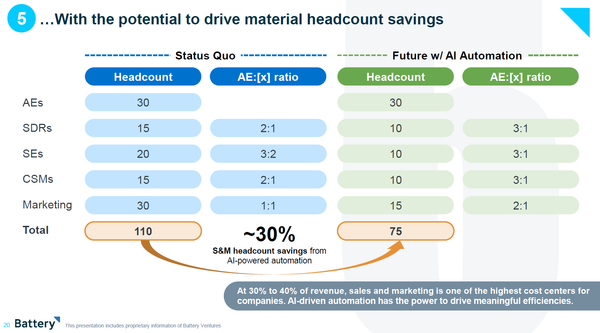
  • What will be the impact of AI on SaaS budgets? (Here, we discuss some data from the Battery report on State of Enterprise Technology Spending.)
  • How to target and win “experimental AI budget” (that is out there and in no short supply)?
  • How some customer success orgs lost the plot, and became too focused on process (e.g., QBRs) and not enough on sales and renewals.
  • My rule of 30: that expansion ARR should be 30% of new ARR, roughly. Too high and you’re milking the base, and too low and you’re ignoring it
  • Why I love the healthy tension between sales and customer success when they are separated
  • What a “slug” or “zombie” company should do if you’re $15M and growing at 15%
  • Should companies lead or follow on pricing models? (We both firmly believe in using the same pricing model as the leaders in your sector unless you are a pricing model disruptor.)

Here’s the video. Thanks to Jason for a great conversation.