Category Archives: Grateful Dead

Fare Thee Well, Bobby

The first time I heard the Grateful Dead was in the smoking area of my high school. (Yes, high schools had smoking areas in the 1970s.) Someone had brought in a boom box and was playing Wharf Rat, the chorus emerging like an uplifting prayer: “I’ll get up and fly away.”

Around the corner, written on the light brick wall in black, permanent ink was a line that the grafitti artist foresaw as iconic: “What a long strange trip it’s been.” The Dead permeated my high school like tie-dye through the fibers of a white, cotton t-shirt.

Such was high school in the 1970s. While I’m not in the photo below, it’s the only one could easily find online, just to give you a taste. While I don’t know what happened to most of the folks in this picture, one later became principal of the high school. Another was killed in 9/11. But this was us.

Irvington High School classmates

Many of us became deadheads. Second only to their home state of California (847), the Dead played more shows in New York (289) than any other. Often these were in small municipal or college venues like the Glens Falls Civic Center, the Onondaga War Memorial, the Broome County Arena, or Barton Hall at Cornell, later famous for hosting what was generally deemed their single best concert.

I was first drawn to Phil because the tone of his voice was unique and I loved the high harmonies that he often sang. Then I was drawn to Jerry because of his souful voice, wistful ballads, stunning guitar leads, and well, who couldn’t be drawn to Jerry?

I didn’t know what a rhythm guitarist was. But that was Bob Weir, often simply Bobby, cofounding member but nevertheless kid brother of the band. He was only 17 when he joined, compared to Garcia at 21, and Lesh at the ripe old age of 25.

Garcia, Lesh, and Weir at the Warfield in 1980

But I liked Weir’s high energy songs like Truckin’ and Sugar Magnolia, which often served as a gateway into the Dead’s music. And Sugar Magnolia contains one of my favorite Dead lyrics (“she’s a summer love in the spring, fall, and winter”) although it was penned by Robert Hunter.

A dispute with Hunter over the previous line — “she can jump like a Willys in four-wheel drive,” written by and classic Weir — permanently ended their songwriting partnership, driving Weir to collaborate with John Barlow going forward. Weir and Barlow would write some masterpieces together such as Weather Report Suite, a song so challenging to play that the band eventually stopped playing it.

But that was the Dead. A band that wrote songs that were too hard to play. The band that routinely played the most difficult thing that John Mayer ever learned. The band who built a public address system that was too expensive to transport. The band that wrote songs in 11/8 and 7/4 time signatures (The Eleven, Estimated Prophet). The band that encouraged bootlegged recordings with a dedicated “tapers” section. The band that provided medical and retirement benefits for its road crew. The band that pioneered a new category (“jam bands”), blazing a path in the 90s for Phish and today Goose.

Tapers at a Dead show in Berkeley

These were people who pushed the envelope. And Bob was a big part of that. Perhaps the biggest thing Bob did in recent years was recruit talent to keep the band going. John Mayer, Oteil Burbridge, Jeff Chimenti, and eventually Jay Lane. Without Bobby attracting this talent, the whole scene might have died with Garcia in 1995.

In other posts, I’ve written about business lessons from the Dead and there are plenty. Innovation, disruption, open source, community, alternative business models, category creation, customer centricity. I won’t rehash them here. If I had to net it all out, I’d say read Brian Halligan’s book. He knows the Dead, he knows marketing, and — as a cofounder of HubSpot — he knows tech.

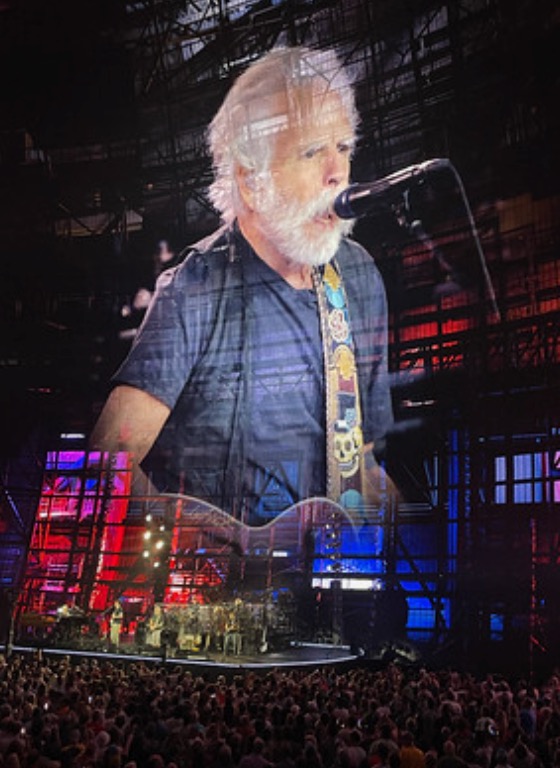
Those of us in community knew that, as great as it was, it couldn’t last forever. The Sphere shows were epic.

Bobby at the Sphere

So were what turned out to be the final shows in Golden Gate Park. Particularly moving were the nightly guest appearances: Graheme Lesh (Phil’s son), Trey Anastasio, and Sturgil Simpson who knocked Morning Dew literally out of the park.

After Garcia’s death, Weir was once asked how often he thought about him. “Quite often,” Weir responded. “You know, he lives and breathes in me.”

And so it will be, Bobby, between you and us. Thanks for everything. Thanks for the long strange trip. Fare thee well.

A Box of Rain Will Ease the Pain

While I’d been using the Internet since the early 1980s in my student job at Lawrence Berkeley Lab, the first time I remember using the worldwide web was in the mid 1990s. Well, August 9th, 1995, to be more specific.

I’d recently moved to Paris and heard about this layer atop the Internet that relied on hypertext transfer protocol to connect web browsers and web sites. Having seen what Apple had done with hypertext up that point, I wasn’t prepared to be impressed. So I fired up a browser and, to reconnect with home, I went to sfexaminer.com. The headline read:


“God, I hate this thing!” As an inveterate deadhead, the news was devastating if not entirely surprising. The episode set my web adoption back by a few years. While I won’t dive into my history following the band, I’ll show you the back of the car that we keep at our house in Oregon. (Morning Dew.)


Four years earlier, we’d lost the power in our Marin County home the night Bill Graham died in a helicopter crash west of Vallejo. If I was connected to Graham’s death via a power line, I was connected to Garcia’s via the web.

An SMS message connected me to last Friday’s death of Phil Lesh. Sent by a friend from so long ago that my phone no longer recognized his number, the news arrived as anonymous text message, containing only a link to the story.


I’ve written before (and as recently as three weeks ago) about business lessons from the Dead, so I won’t cover that again. Instead, as my tribute to Phil, I’ll write briefly about the power of metaphor using one of the relatively few Dead songs he wrote: Box of Rain. It’s also one of my favorites.

The song deals with Lesh’s feelings during the lingering, terminal illness faced by his father. Grateful Dead lyricist Robert Hunter worked with Lesh on the lyrics, and they are some of Hunter’s finest.

You can hear the frustration and impotence in battling illness via lines like:

“What do you you want me to do, to do for you, to see you through?”

The power and beauty of the song, however, comes from the primary metaphor: the box of rain.

“Just a box of rain, wind, and water. Believe it if you need it, if you don’t just pass it on.”

But what is this box of rain? It’s a metaphor. In fact, it’s a metaphor within a metaphor.

Hunter was thinking along the lines of a “ball of rain,” but that was probably both too obvious and insufficiently poetic. So the ball became a box. (Hence, the inner metaphor.)

So what is this ball of rain, wind, and water?

It depends on perspective, and in this case you’re going to need a wide one. Seen from far enough away, that ball of rain is our home. The earth.

“It’s just a box of rain, I don’t know who put it there. Believe it if you need it, and leave it if you dare.”

Once you understand the metaphor, that’s pretty literal.

“And it’s just a box of rain, or a ribbon for your hair.”

Hunter loved to write about certain things, such as calliopes and ribbons. While hard to interpret, I think this line is another metaphor. What do ribbons do for hair? Make it more beautiful. What does the box of rain do for the universe? The same thing. The earth is just a ribbon in the hair of the universe.

It adds a sense of utter smallness, rivaled only by how Tralfamadore used the earth in The Sirens of Titan.

(I feel obliged to say that Hunter hated to interpret his lyrics, maintaining that it wasn’t about what the words meant to him: it was about what they meant to you. He didn’t want his meaning to ruin your meaning. At first, the puzzle-solver in me found this offensive, but over time I’ve come to realize that it’s actually pretty cool.)

Now we’re ready for the last line.

“Such a long, long time to be gone and a short time to be there.”

There, of course, being here. On our box of rain. In this life. On this earth.

Thank you Phil for always putting the music first, the culture, and the reminder. May we all spend our time here as well as you spent yours.

Marketing Lessons from the Grateful Dead by Scott and Halligan: A Belated Book Review

Since It Costs A Lot to Win, and Even More to Lose [1]

It’s hard for a DNA-level marketer and inveterate deadhead [2] to review a book that fuses both. While I first read Marketing Lessons from the Grateful Dead not long after its publication in 2010, I’d never wanted to write about it. There was too much to say, the subject too close to home, and the Dead were becoming passé anyway — who’d want to learn lessons from a band that supposedly peaked on 5/8/77 and that played its last show on 7/9/95?

Since then, three things happened:

  • Since 2015, John Mayer has breathed new life into the band, bringing new and younger fans to the community. Dead tribute bands blossomed and now play at swanky Nantucket venues [3]. My son started to borrow my old t-shirts to attend NYU college parties. Unexpectedly, the Dead became cool again.
  • I internalized that one of the authors, Brian Halligan, was the founder/CEO of HubSpot and that should, well, automatically make the book significant. [4] [5]
  • I recently had a series of conversations with Jacquelle Amankonah Horton, the dynamic founder of Fave, where I found myself talking about community to someone in the music business, something I find pretty much impossible to do without talking about the Dead. Those chats re-energized me on the whole topic.

So here we are. Let’s do my long overdue review of Marketing Lessons from the Grateful Dead.

Before diving in, let’s note that this book is not the only attempt to take business lessons from the Dead. Other notable efforts include:

Once in a While You Get Shown the Light in the Strangest of Places [9]

So, does this book show us the Dead’s marketing light in a way that can be applied more generally to business? Yes. It does. Though, to split hairs, I’d argue it’s more a book about strategy than marketing [10].

The book is structured in three sections. Each chapter discusses a principle from the Dead and a company that demonstrates the principle. While the chapters-as-lessons structure works, the consistent alternation between principles and examples makes the book feel somewhat formulaic. And, because tech changes a lot in 15 years, while the principles are timeless, the examples are often not (e.g., Mashable, MySQL, StumbleUpon) [11].

The first section takes lessons from the band:

  • Create a unique business model. The Dead made money selling tickets, not albums. This was, and is, pretty unusual in the music business.
  • Choose memorable brand names. The Grateful Dead is a memorable name, and far superior to their previous one, The Warlocks.
  • Build a diverse team. The musicians came from different backgrounds. Garcia loved bluegrass, Lesh was trained in classical jazz, and Pigpen was a blues harmonica player. You can get a 1+1 = 3 effect from the fusion.
  • Be yourself. The Dead were authentic in general and transparent about mistakes.
  • Experiment, experiment, experiment. A product of the Acid Tests, the band was born experimental and improvisational. They were always trying new and creative things (e.g., a song in 11/8 time).
  • Embrace technology. The most notable example was The Wall of Sound, a 600-speaker public address system that delivered unparalleled sound quality (and took four semi trucks to carry), but quickly proved impractical for a touring band [12] [13].
  • Establish a new category. The Dead defined a new category of music, which only after several decades got a name (“jam bands”). They were very much a category creation story [14].

The second section takes lessons from the fans:

  • Encourage eccentricity. Eccentricity was embraced by the band and its fans, allowing everyone to be themselves.
  • Bring people on an odyssey. The Dead, starting with a mailing list hooked to a San Rafael post office box, made fans an equal part in the journey (aka, the long strange trip).
  • Put fans in the front row. The band set up their own direct ticketing operation to ensure fans fair access to tickets [15].
  • Build a following. The Dead were pioneers in database marketing (and subsequent techniques) to cultivate the fan base.

The last section takes lessons from the business:

  • Cut out the middleman. Their direct ticketing operation not only enabled fair access, but it reduced costs, allowing the band to gross 100% of ticket sales.
  • Free your content. The Dead allowed fans to tape concerts, nearly unique in the industry, and an open source approach that helped new fans enter the scene.
  • Be spreadable. Concert tapes became collectibles that were copied and traded [16], whether between individuals or in Shakedown Street swap meets before and after shows.
  • Upgrade to premium. While the band allowed taping, they nevertheless released live albums, with amazing sound quality such as Europe 72 or Skull and Roses [17].
  • Loosen up your brand. While the Dead had standard icons, they defined a broad visual style and allowed improvisation within it. Contrast this to typically strict corporate branding style guides that stifle creativity in the name of consistency [18].
  • Partner with entrepreneurs. Rather than ban the use of their imagery, the Dead licensed it to entrepreneurs who could make and sell their own merch.
  • Give back. From benefit concerts to community support to the Rex Foundation, the Dead gave back, long before it was corporate-fashionable to do so.
  • Do what you love. My survivor bias detector triggers whenever I hear this, but the book’s point is more fundamental: if they didn’t love what they did, they couldn’t have kept doing it for more than 2,300 concerts.

Sometimes We Walk Alone [19]

When writing about the Dead, most people capture the contrarian, rule-breaking nature of the band. It’s hard to miss. The book does that and extracts 19 individual lessons that can be taken from the Dead’s success. Frankly, I’d have preferred if they took fewer lessons and examined them in more depth, as does Everything I Know About Business I Learned from The Grateful Dead.

What the book really misses, however, is the strategic consistency across the lessons. Using the language of Richard Rumelt, the book notes 19 different actions undertaken by the Dead, but fails to recognize that they are coherent actions driven by an overall guiding policy. Much as Costco works spectacularly well not because of the fifty things they do differently, but because of how those fifty things work together, so it is with the Dead.

The improvisational format means every show is different. That enables fans to attend consecutive shows, which enables fans to tour with the band, which in turn enables the Shakedown Street tailgates and community. The ability to tape concerts combined with the improvisational format means that each show is unique and ergo recordings become collectibles, further enabling the community. Licensing merchandising rights to small vendors enables the tailgate scene and nomadic vendors, who can effectively earn a living touring with the band (and using proceeds to buy tickets). Commitment to fan experience means playing small venues, and improvisational shows enables playing small venues for consecutive nights. This enables the community scene while the direct ticket operation keeps ticket prices reasonable despite the restricted supply.

You can allow taping, but if every show is the same, the tapes won’t be valued. You can play small venues, but if you don’t control ticket sales, pricing will box out your best fans. You can play in an improvisational format, but if you don’t repeat nights at venues and move in slow and systematic fashion, you won’t enable fans touring with the band and the community parking lot scene.

It is not any one of the lessons that matters. It is the strategic consistency across them that creates the magic.

Switching to Blue Ocean Strategy as my strategic reference, the Dead re-invented rock music in the same way that Cirque du Soleil re-invented the circus. They took the fundamental levers of the business (what the authors call a strategy canvas) and reset them to create an entirely different type of product.


For the Dead, this is best reflected by the old deadhead saying, “there is nothing like a Grateful Dead concert.” That’s because the levers are set differently.

Come and Join the Party

I’ll conclude with the original invitation to the Grateful Dead party: the first verse of The Golden Road to Unlimited Devotion, the first song of their first album. A song about The Summer of Love [20].

See that girl, bare-footin’ along,
Whistlin’ and singin’, she’s a carryin’ on.
There’s laughing in her eyes, dancing in her feet,
She’s a neon-light diamond and she can live on the street.
Hey, hey, hey come right away.
Come and join the party, every day.

That invitation, some 57 years later, remains open.

# # #

Notes

[1] Opening line of Deal, an upbeat song in the band’s Americana catalog. Guitar players (or those interested in music) should check out this Guitar Teacher Reacts video by Michael Palmisano.

[2] 300 or so shows and counting, including all variations.

[3] I’ll refer to the Dead as a capstone term for The Grateful Dead, the Other Ones, The Dead, Furthur, Fare Thee Well, Dead & Company, and other variations. When a band is 50+ years old, you can end up with numerous incarnations.

[4] I knew it in 2010, but somehow forgot it over the years and was frankly surprised to rediscover it only fairly recently.

[5] And the co-author, David Meerman Scott, is no schmo. He’s a well-known marketing author and speaker.

[6] The general idea being that all strategy is improvisation because things change so quickly, and ergo that companies should view strategy as structured chaos.

[7] “So can I go into the show,” to complete the famous fan quote from the The Grateful Dead Movie.

[8] Surprisngly, two of the three authors were at the Theoretical Division, Center for Nonlinear Studies at Los Alamos National Lab. Technically, this paper isn’t really trying to extract business lessons from the Dead, but I think we find one anyway in that fundamental tension, which in software would be expressed by “what we want to build” vs. “what they want to use.”

[9] One of the most-quoted Dead lyrics, from Scarlet Begonias. The complete line is “once in a while you [can] get shown the light, in the strangest of places if you look at right.” In 1976, they inserted the [can], which subtly changed the meaning, for the worse in my opinion. But to demonstate the depth of the Dead rabbit hole, go to the Good Old Grateful Deadcast for a two-hour exploration of this one song.

[10] Strategy is a little tricky to classify. Corporate strategy is definitionally company-level and I’d classify most of the lessons in this book as corporate strategy, not marketing strategy. For those who consider corporate strategy formulation a marketing duty (and I’m one of them), remember that marketing (or corporate development) typically drives the strategy formulation process (e.g., the offsite, the agenda, the topics, the pre-reading and data). But driving the process and “owning strategy” (i.e., its result) are two different things.

[11] Timeless principles can hopefully be illustrated with timeless examples. They did this in cases (e.g., Ronald McDonald house), but perhaps the temptation to use hot contemporary examples (that invariably date the work) was too strong. Songwriters face the same tension and Dead lyricist Robert Hunter did a fantastic job of resisting it, writing timeless lyrics as a result. In fact, the famous spat that ended collaboration between Hunter and Bob Weir was over Weir’s insertion of “Jump like a Willys in four-wheel drive” into Sugar Magnolia. Hunter strongly objected, I’m guessing, not only for artistic reasons, but because it would date the lyrics.

[12] A short video overview of the three-story Wall of Sound is provided here.

[13] Some enthusiastic fans recently built a half-scale wall of sound.

[14] Dispelling the myth that the category name matters enormously. Focus on building the category, the name can come later.

[15] While Billy Joel never tried to disintermediate ticket sellers, he does seem to have a fans in the first row policy as well. Few others do.

[16] In the analog tape world, copying was not lossless, so tapers would careful try to track the “generation” of the tape (original, copy, copy of copy, etc.)

[17] The amazing quality was achieved not only through high-quality audio equipment, but also through some level of studio doctoring of the recordings, e.g., overdubs.

[18] My definition of visual branding is: do we look like us? Attaining this goal is typically done via strict standards, but a few organizations manage to define a broader look and allow innovation within. The Dead were great at this. Salesforce does a pretty good job as well.

[19] From Eyes of the World.

[20] The Golden Road to Unlimited Devotion. The Summer of Love was also the inspiration for the more famous, San Francisco Be Sure to Wear Flowers in Your Hair by Scott McKenzie, and one far more famous song than that, All You Need Is Love by the Beatles.

What is a Minimum Viable Product, Anyway? My Favorite MVP Analogy.

The concept of minimum viable product (MVP) has been popularized in the past decade thanks to the success of the wonderful book, The Lean Startup.  It’s thrown around so casually, and you hear it so often, that sometimes you wonder how — or even if — people define it.

In this post, I’ll describe how I think about MVPs, first using one real-life example and then using my favorite MVP analogy.

The concept of a minimum viable product is simple:

  • Every startup is basically a hypothesis (e.g., we think people will buy an X).
  • Instead of doing a big build-up during a lengthy stealth phase concluding in a triumphant (if often ill-fated) product unveiling, let’s build and ship something basic quickly — and start iterating.
  • By taking this lean approach we can test our hypothesis, learn, and iterate more quickly — and avoid tons of work and waste in the process.

The trick is, of course, those two pesky words, minimum and viable.  In my worldview:

  • Minimum means the least you can do to test your hypothesis.
  • Viable means the product actually does the thing it’s supposed to do, even in some very basic way.

I’ll use an old, but concrete, example of an MVP from my career at Business Objects.  It’s the late 1990s.  The Internet is transforming computing.  We sell a high-functionality query & reporting tool, capable of everything from ad hoc query to complex, highly-formatted reports to interactive multidimensional analysis.  That tool is a client/server Windows application and we need to figure out our web strategy.  We are highly constrained technologically, because it’s still the early days of the web browser (e.g., browsers had no print functionality) [1].

After much controversy, John Ball and the WebIntelligence team agreed on (what we’d now call) the following MVP:

  • A catalog of reports that users can open/browse
  • End-user ad hoc query
  • Production of very basic tabular reports
  • Semi-compatibility with our existing product [2]

But it would work in a browser without any plug-ins, web native.  No multi-block reports.  No pages.  No printing.  No interactive analysis.  No multidimensional analysis.  No charting.  No cross-tabs.  No headers, no footers.  Effectively, the world’s most basic reporting tool — but it let users run an ad hoc query over the web and produce a simple report.  That was the MVP.  That was the hypothesis — that people would want to buy that and evolve with us over time.

Because of that tightly focused MVP we were able to build the product quickly, position it clearly within the product line [3], and eventually use it as the basis for an entirely new line of business [4].

Now, let’s do the analogy.  Pretend for a moment we’re in a world where there are no four-wheel drive cars.  We have invented the four-wheel drive car.  We imagine numerous use-cases [5] and a big total available market (TAM).

What should be our MVP?  Meet the 1947 Jeep Willys [6] [7].

No roof.  No back seat.  In some cases, no windscreen.  No doors.  No air conditioning.  No entertainment system.  No navigation.  No cup holders.  No leather.  No cruise control.  No rearview camera.  No ABS.  No seatbelts.  No airbags.

No <all that shit that too many product managers say are requirements because they don’t understand what MVP means>.

Just the core:  a seat, a steering wheel, an engine, a transmission, a clutch, and four traction tires.

  • Is it missing all kinds of functionality?  Yes
  • In this case, would it even be legal to sell?  No.  Well, maybe off-road, but we’re in analogy-mode here.
  • But can it get you across a muddy field or down a muddy road?  YES.

And that’s the point.  It’s minimum because it’s missing all kinds of things we can easily imagine people wanting, later.  It’s viable because it does the one thing that no other car does.  So if you need to cross a muddy field or go down a muddy road, you’ll buy one.

As Steve Blank says:  “You’re selling the vision and delivering the minimum feature set to visionaries, not everyone” [8]. 

So next time you think someone is focused on jamming common but non-core attributes into an MVP, tell them they’re counting cupholders in a Willys and point them here.

# # #

Notes

[1] And printing is a pretty core requirement for a reporting application!

[2] This was key.  WebIntelligence could not even open a BusinessObjects report.  Instead, we opted for compatibility one layer deeper, at the semantic layer (that defined data objects and security) not the reporting layer.

[3] If you want all that power, use BusinessObjects.  If you want web native, use WebIntelligence.  And you can share semantic layer definitions and security.

[4] BI extranets.

[5] From military off-road applications to emergency off-road and/or slippery conditions to sand recreational to family vehicles on snow and many  more.

[6] Which in some ways literally was the MVP for Jeeps.

[7] Popularized by the Grateful Dead in Sugar Magnolia (“… jump like a Willys in four-wheel drive.”)

[8] Where I’ll define visionary as someone who has the problem we’re trying to solve and willing to use a new technology to solve it.  It’s a little easier to think of someone trying a next-generation database system as a “technology visionary” than the Army buying a Jeep, but it’s the same characteristic.  They need a currently unsolvable problem solved, and are willing to try unconventional solutions to do it.

Strategic Focus: I’m Just Trying to Get My Space Together

As a long-time Grateful Dead fan, I have to say that I was advantaged in understanding how the Blown to Bits problem would affect digital media businesses.  You see, for years, the Dead had changed the business model of the music industry, choosing to use albums as a loss leader and to make money on live concerts, playing some 2,300 concerts together, not to mention those done individually by band members (e.g., Jerry Garcia at the Keystone Berkeley).

steal your face

The Dead even had a tapers section at most concerts and sometimes could be heard literally stopping the show to allow someone to reposition their microphones.  The Dead have a valid claim to “we did Freemium 30 years before Freemium was cool.”

While I won’t go as far to say that Everything I Learned about Business, I Learned from the Grateful Dead (a good book that takes top ten lessons from “the long, strange trip”), I do believe the Dead were both musical and business model innovators.

Improvisation as strategy was profiled in Competing On The Edge:  Strategy as Structured Chaos, published by Harvard Business School press.  Excerpt:

The Grateful Dead met this challenge through improvisation […] as distinguished by two key properties:  first, performers intensely communicate with each other in real time […] second, they rely on a few very specific rules, such as who plays first, what are the permitted chords, and who follows whom.

While I’m riffing on the Dead, I should probably also mention Marketing Lessons from the Grateful Dead, a great book on topics including community, branding, customer centricity, teamwork, category creation, technological innovation, disruptive business models, disintermediation, and giving back.  The Dead were innovators in all these areas and the book is well worth reading.

My favorite Dead-related quote, however, comes not from that book but from The Grateful Dead Movie, in a famous scene where a completely zonked head is ambling around outside the concert and tells a security guard the inimitable:

“I’m just trying to get my space together, so that I can go into the show.”

I always think of this guy whenever I talk to a startup about strategy.  Why?  Because startups are very much about trying to get your space together.

  • What space do you want to be in?
  • Against whom do you want to compete?
  • Where do you draw the boundaries on your space?
  • What adjacent spaces, if any, do you want to incorporate into your space?
  • In what adjacent spaces do you want to partner?
  • How do you see the boundaries on your space evolving over time?

My meta-answer to these questions is “the world is a very large place.”  How does that relate?  In two ways.  It means first that you better define your space in such a way that you are truly world-class within it — and not using world-class as a nice sounding compound adjective, but really grokking its meaning:  what can you truly be best in the world at doing?  Second, it means that because the world is a big place that you can turn what might appear to be a small niche into a  very big business if you are truly the best in the world.  So don’t be afraid to focus.

Most startups forget focus too early and delude themselves into thinking they can be world-class in across a number of areas.  Take enterprise performance management (EPM) — the space in which Host Analytics competes –for example.  EPM is a $4B market for financial analytic applications that is adjacent to the broader $13B business intelligence (BI) market.  Some of our competitors consider themselves addressing the (incorrectly calculated) “$33B BI market” and are either building or acquiring products in the broader BI space?  It sounds good from a total available market (TAM) perspective.  Wow!  You’ve tripled your TAM.

But think for a minute — what are the odds that  your cheaply-acquired or hastily built BI tools are world-class?  None.  So all you’ve really done is dilute your focus on EPM by complementing it with some third-tier BI.  A far better solution (and the one we follow at Host Analytics) is to partner with someone else who is spending all their energy focused on being world-class in the adjacent space.  In our case, that partner is Birst who is focused on being world-class at cloud BI.

So if you’re thinking of starting a company, ask yourself:  what can we really be world-class at doing?

Answering that question is the only way to get your space together, before you go into the show.