Fast Search to Restate 2006 Results (As Predicted)

As predicted in this post, Fast Search & Transfer yesterday announced that it intends to restate 2006 results. See this Reuters story, entitled Norway’s Fast Says to Restate 2006 Results, for more. Excerpt:

“The effects of such restatements have not yet been established in detail, and Fast is taking appropriate steps to ensure a quick and proper process,” Fast Search & Transfer said in a statement.

“Restatements of the 2006 accounts may have an effect on the 2007 accounts,” the company said.

It’s hard to imagine that this will have any effect on the Microsoft offer, as a restatement was easily anticipated given all the account receivables write-offs, and one must assume that Microsoft learned plenty about Fast’s financials during the due diligence prior to their bid.

Forbes.com has a similar story on the restatement, here.

Sun Buys MySQL for $1B

I feel like this is becoming an M&A blog, but there been a lot of relevant M&A activity of late that I felt I needed to cover (e.g., Microsoft/FAST, EMC/Document Sciences).

Yesterday’s big news (aside from Oracle / BEA for I think $8.5B) was Sun announcing that it would buy MySQL for $1B.

Frankly, this deal caught me by surprise. I’ve been critical of Sun at times, but I think this is a smart move for them. It continues their trend of trying to offer open source and/or cheap software tools (e.g., Star Office) that undermine incumbents in large markets. And it will help them transition to from a wounded workstation and server company to something else. What “something else” is I’m not sure. I am sure, however, that they can’t stay still, so in a sense any motion represents potential progress.

Schwartz is an active CEO blogger (gotta love that), so he has written his own extensive post on the deal, here. Excerpts:

But the biggest news of the day is… we’re putting a billion dollars behind the M in LAMP. If you’re an industry insider, you’ll know what that means – we’re acquiring MySQL AB, the company behind MySQL, the world’s most popular open source database …

But as I pointed out, we heard some paradoxical things, too. CTO’s at startups and web companies disallow the usage of products that aren’t free and open source. They need and want access to source code to enable optimization and rapid problem resolution (although they’re happy to pay for support if they see value). Alternatively, more traditional CIO’s disallow the usage of products that aren’t backed by commercial support relationships …

So why is this important for the internet? Until now, no platform vendor has assembled all the core elements of a completely open source operating system for the internet. No company has been able to deliver a comprehensive alternative to the leading proprietary OS. With this acquisition, we will have done just that – positioned Sun at the center of the web, as the definitive provider of high performance platforms for the web economy. …

Information Week covers the deal here.
EMC Acquires Document Sciences for $85M

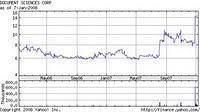
On 12/27/07, EMC announced the acquisition of Document Sciences (DOCX) for $85M in cash. DOCX’s stock has been flat in the $6 range for most of the past two years, recently moved to the $8 range, and is up to about $14 on the announcement of the deal.

The New York Times reports on the story here. Excerpt:

Storage company EMC has agreed to buy Document Sciences, a developer of software for personalizing mailshots and other communications. The acquisition will allow EMC to extend its offering in the field of transactional content management, which it sees as the fastest-growing part of the enterprise content management market. It plans to incorporate Document Sciences into its content management and archiving division.

Alan Pelz-Sharpe of CMSWatch has a nice write-up here. Excerpt:

The storage centric, archiving / transactional document management story now being built by EMC positions them to play more strongly in the ever-changing ECM market. For a long time Documentum was a leader in ECM, but over the last 2 years they have lost their shine and momentum. Of course it will take time for the acquisitions to be absorbed, for the new “D6” version to be truly tested and worked out by the market, and for EMC to build a cohesive and comprehensive technical architecture across its product line. And so for buyers, EMC remains a turbulent vendor to deal with. But the moves they are making seem solid, and the prognosis looks good. It’s a developing story that I will continue to cover in detail in the ECM Suites Report throughout 2008.

Microsoft Bids $1.2B for Fast Search and Transfer

It’s a busy week so no time for a deep analytical post (yet), but I wanted to get this news out fast. Microsoft has bid $1.2B for Fast Search & Transfer. See this New York Times story for more.

My initial take:

  • It’s a quite healthy valuation of ~8x the revenue run-rate, partially justified by an above-average growth rate. (Disclaimer: numbers approximate and from memory.)
  • Some of it, I bet, is psychological, because $1.2B gets back to the “recent” peak valuation (during the past year), prior to the accounting scandals which rocked the company and whacked the stock. In my experience, company sellers tend to hang on emotionally to “recent” highs in deciding their price. Sometimes they get the old valuation back. Sometimes they don’t. In Fast’s case, the 52-week range was ~8.5 to 18.5 kroner. The deal is, I believe, at 19 kroner. (Note that the chart seems to miss the last day’s trading, which took the stock up to about 18.5 kroner.)
  • It seems a logical ending for Fast. As I pointed out a few times in this blog, Fast was letting the same guys who got the company in trouble continue to run the company (with one or two changes). I thought this was a mistake. I thought it didn’t hold the executives accountable. I thought they wouldn’t be able to fix the problems. So selling to Microsoft seems a practical solution to these problems.
  • This post on the Microsoft Enterprise Search Blog quotes Kirk Koenigsbauer, General Manager of the SharePoint Business Group, which suggests that the SharePoint team drove the acquisition.
  • A friend at Microsoft had this to say: “[the] deal was all about enterprise search competitiveness (at the high end) vs. Google and to an extent IBM. Both search engine capabilities and connectivity to line of business [systems], content management, and other data sources.”

More coverage:

Facebook News Parody Video

Making the point that messages don’t always carry well across media, check out this video parody of Facebook, translating it from webpage to live TV news show. Enjoy.