Thoughts on the Jive Registration Statement (S-1) and Initial Public Offering (IPO)

I finally found  some time to read over the approximately 175-page registration statement (S-1) that enterprise social networking software provider Jive Software filed on August 24, 2011 in support of a upcoming initial public offering (IPO) of its stock.

In this post, and subject to my usual disclaimers, I’ll share some of my thoughts on reading the document.

Before jumping into financials, let’s look at their marketing / positioning.

  • Jive positions as a “social business software” company.   Nice and clear.
  • Since everyone now needs a Google-esque (“organize the world’s information”) mission statement, Jive has one:  “to change the way work gets done.”  Good, but is change inherently a benefit?  Not in my book.
  • Jive’s tagline is “The New Way To Business.”  Vapid.
  • Since everyone seems to inexplicably love the the tiny-slice-of-huge-market argument in an IPO, Jive offers up $10.3B as the size of the collaborative applications market in 2013.  That this implies about 2% market share in 2013 at steady growth doesn’t seem to bother anyone.  Whither focus and market dominance?

Now, let’s move to financials.  Here’s an excerpt with the consolidated income statement:
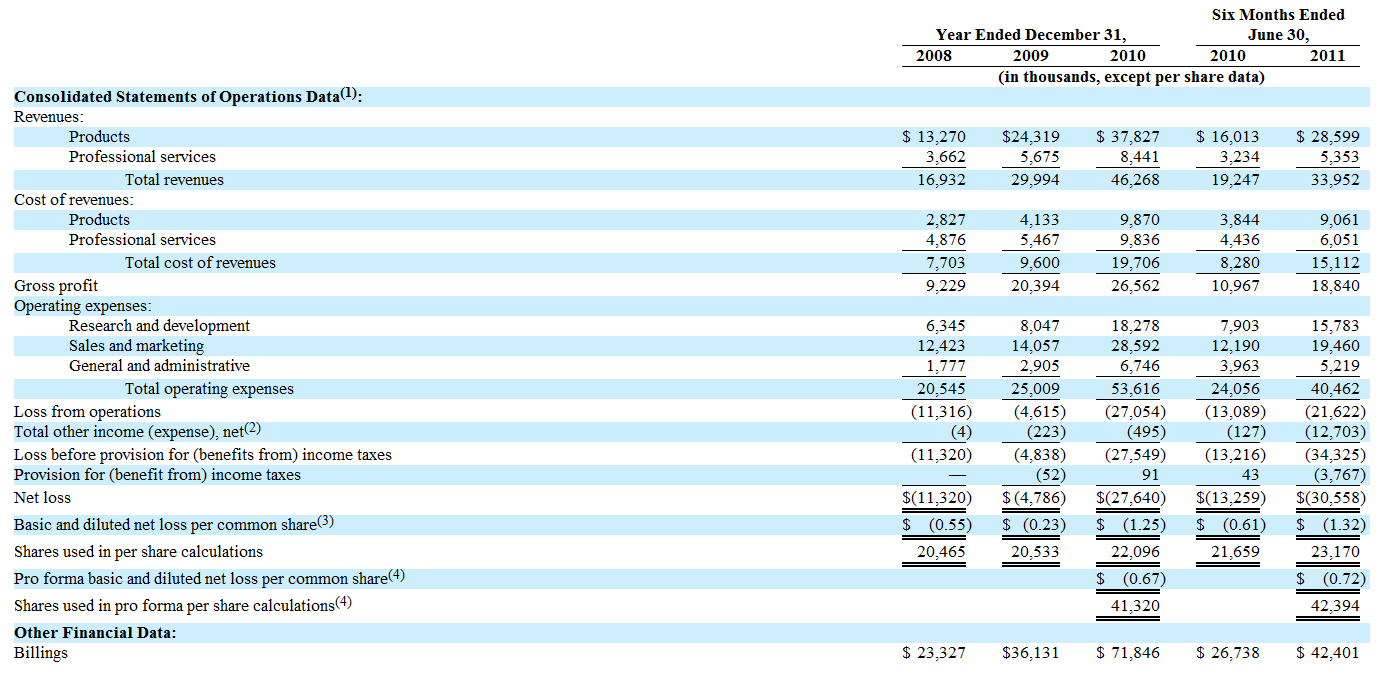
The astute reader will notice a significant change in 2010 when Jive Founder Dave Hersh stepped down as CEO and was replaced with ex-Mercury CEO Tony Zingale.  Let’s make it easier to see what’s going by adding some ratios:
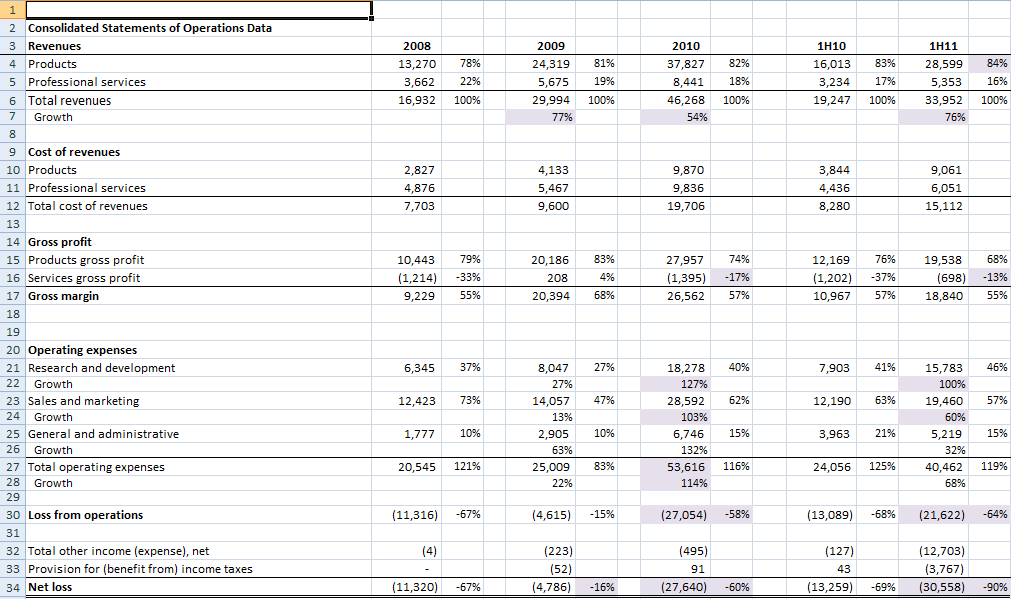
Translating some of the highlighted cells to English:

  • Jive does not make money on professional services:  they had a -17% gross margin 2010 and -13% gross margin in 1H11.
  • In 2009,  a very difficult year, Jive grew total revenue 77% and did so with a -15% return on sales.
  • In 2010, Jive grew revenue 54% with a -60% return on sales, while in 1H11, Jive grew revenue 76% with a -64% return on sales.
  • In 2010, Jive increased R&D, S&M, and G&A expense by 127%, 103%, and 132% respectively.
  • In 2010, Jive had a $27.6M operating loss, followed by a $30.6M operating loss 1H11

To say that Jive is not yet profitable is like saying the Tea Party is not yet pro-taxation.  For every $1.00 in revenue Jive earned in 1H11, they lost $0.90. People quipped that the Web 1.0 business model was “sell dollars for ninety cents.”  Jive seems to be selling them for about fifty-three.

But that analysis is unduly harsh if you buy into the bigger picture that:

  • This is the dawn of a large opportunity; a land-grab where someone is going to take the market.
  • You assume that once sold, there are reasonably high switching costs to prevent a customer from defecting to a competitive service.
  • These are subscription revenues.  Buying $1.00 of revenue for $1.90 is foolish on a one-shot deal, but in this case they’re buying a $1.00 annuity per year.  In fact, if you read about renewal rates later on in the prospectus, they’re actually paying $1.90 for a $1.00 annuity that grows at 25% per year.

I’d say this is a clear example of a go-big-or-go-home strategy.  You can see the strategic tack occurring in 2010, concurrent with the management change.  And, judging by the fact that they’re filing an S-1, it appears to be working.

Before moving on, let’s look at some ratios I calculated off the income statement:
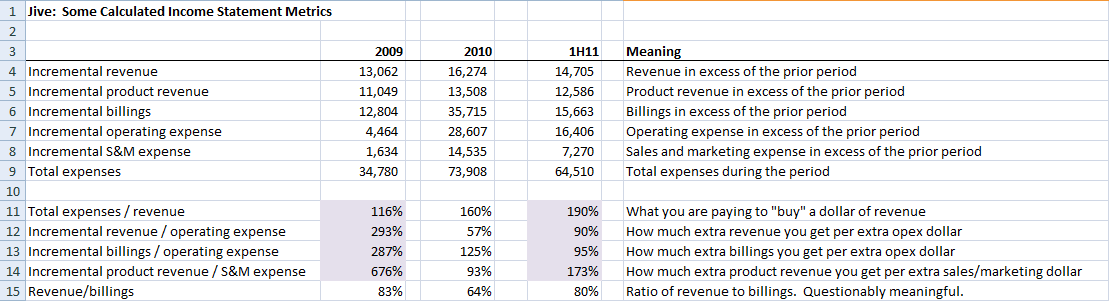
You can see the strategy change in the highlighted cells.

  • Before the change, Jive spent $1.16 to get a dollar of revenue.  After, they spent $1.90.
  • Before, they got $2.91 of incremental revenue per incremental operating expense.  After, they got $0.90.  (It looks similar on a billings basis.)
  • Before, they got $6.76 of incremental product revenue per incremental S&M dollar.  After, they got $1.73.

Clearly, the change was not about efficiency.  You could argue that it was either about growth-at-all-costs or, more strategically, about growth as a landgrab.

But we’re only on page 6 of the prospectus, so we’re going to need to speed up.

Speaking of billings and revenues, let’s hear what Jive has to say:

We consider billings a significant leading indicator of future recognized revenue and cash inflows based on our business model of billing for subscription licenses annually and recognizing revenue ratably over the subscription term. The billings we record in any particular period reflect sales to new customers plus subscription renewals and upsell to existing customers, and represent amounts invoiced for product subscription license fees and professional services. We typically invoice the customer for subscription license fees in annual increments upon initiation of the initial contract or subsequent renewal. In addition, historically we have had some arrangements with customers to purchase subscription licenses for a term greater than 12 months, most typically 36 months, in which case the full amount of the agreement will be recognized as billings if the customer is invoiced for the entire term, rather than for an annual period.

The following table sets forth our reconciliation of total revenues to billings for the periods shown:

This says that billings is equal to revenue plus the change in deferred revenue.  Billings is a popular metric in SaaS companies, though often imputed by financial analysts, because revenue is both damped and seen as a dependent variable.  Billings is seen as the purer (and more volatile) metric and thus seen by many as a superior way to gauge the health of the business.

For Jive, from a growth perspective, this doesn’t strike me as particularly good news since billings, which were growing 99% in 2010, are growing at 59% in 1H11, compared to revenue which is growing at 76%.

Now we’re on page 8.  Happily the next 20 pages present a series of valid yet unsurprisingly risk factors that I won’t review here, though here are a few interesting extracted tidbits:

  • The company had 358 employees as of 6/30/11.
  • They plan to move from third-party hosted data centers to their own data centers.
  • Subscription agreements typically range from 12 to 36 months.
  • They do about 20% of sales internationally.
  • They recently completed three acquisitions (FiltrboxProximal,  OffiSync).
  • There is a 180 day lockup period following the offering.

Skipping out of page-by-page mode, let me pull some other highlights from the tome.

  • There were 44M shares outstanding on 6/30/11, excluding 15M options, 0.8M in the options pool, 0.9M shares subject to repurchase.  That, by my math, means ~59M fully-diluted shares outstanding after the offering.
  • Despite having $44.6M in cash on 6/30/11, they had a working capital deficit of $15.9M.
  • The Jive Engage Platform was launched in February 2007.  In August 2007, the company raised its first external capital.
  • The Jive Engage Platform had 590 customers as of 12/31/10, up from 468 at 12/31/09.  There were 635 as of 6/30/11.
  • The dollar-based renewal rate, excluding upsell, for 1H11 for transactions > $50K was over 90%.  Including upsell, the renewal rate was 125%.
  • Public cloud deployments represented 59% of product revenues in 1H11.
  • The way they recognize revenue probably hurts the professional services performance because they must ratably take the PSO revenue while taking the cost up-front.

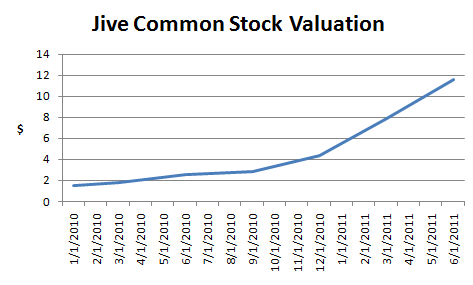
One thing soon-to-be-public companies need to do is gradually align the common stock valuation with the expected IPO price to avoid a huge run-up in the weeks preceding the IPO.  Gone are the days where you can join a startup, get a rock-bottom strike price on your options, and then IPO at ten times that a few weeks later.  Companies now periodically do section 409a valuations in order to establish a third-party value for the common stock.  Here’s a chart of those valuations for Jive, smoothed to a line, over the 18 months prior to the filing.
This little nugget was interesting on two levels, bolded:

The core application of the Jive Engage Platform is written in Java and is optimized for usability, performance and overall user experience. It is designed to be deployed in the production environments of our customers, runs on top of the Linux operating system and supports multiple databases, including Microsoft SQL Server, MySQL, Oracle and PostgreSQL. The core application is augmented by externally hosted web-based services such as a recommendation service and an analytics service. We have made investments in consolidating these services on a Hadoop-based platform.

First, it seems to suggest that it’s not written for the cloud / multi-tenancy (which, if true, would be surprising) and second, it suggests that they are investigating Hadoop which is cool (and not surprising).

More tidbits:

  • 105 people in sales as of 6/30/11
  • 122 people in R&D as of 6/30/11
  • Executives Tony Zingale (CEO), Bryan LeBlanc (CFO), John McCracken (Sales), and Robert Brown (Client Services) all worked at Mercury Interactive.  The latter three were brought in after Zingale was made a director (10/07) but well before he was appointed CEO (2/10).
  • Zingale beneficially owns 7.5% of the company pre-offering.  This is high by Silicon Valley standards, but he’s a big-fish CEO in a small-pond company.
  • Sequoia Capital beneficially owns 36% of the company.  Kleiner Perkins owns 14%.
  • I think Sequoia contributed $37M of the $57M total VC raised (though I can only easily see $22M in the S-1).
  • If that’s right, and if Sequoia eventually exits Jive at a $1B market cap, that means they will, on average across funds, get a ~10x return on their investment.  $2B would give them 20x.

What’s left of my brain has officially melted at page F-11.  If I dig back in and find anything interesting, I’ll update the post.  Meantime, if you have questions or comments, please let me know.

As a final strategic comment, I’d say that investors should consider the possibility of an increased level of competition from Salesforce.com, given their massive push around “the social enterprise” at Dreamforce 11.

Will Oracle or IBM Start a Bidding War with HP over Autonomy?

I’ve heard a fair bit of discussion about whether IBM or Oracle is likely to step in and start a bidding war for Autonomy which HP last week announced that it will buy for $42.21 per share, or $10.2B, as discussed last week in Kellblog when the rumors first surfaced.

My opinion — and this is an educated guess / speculation only — is that the answer is no.  Here’s why:

  • I’m told by those who’ve analyzed the deal that it is a very target-friendly deal on contractual terms as well as price.  HP wants this deal to happen.
  • I’m also told that HP is moving through the acquisition process with great speed.  HP wants this deal to happen.
  • I’m also told that HP is messaging that the deal is not just about buying into unstructured data but also about getting Autonomy’s CIO-level relationships that are supposedly superior to HP’s.  While I’m not sure that Autonomy has great CIO relationships (think:  “let Jimmy here tell you how much you’re going to pay next year”), that’s not the point.  The point is if that HP believes it, the deal becomes about protecting the core as much as about expanding into software which again would suggest that HP wants this deal to happen.
  • Because HP wants the deal to happen, I suspect the deal was not shopped and the first Oracle or IBM heard about it was the announcement.  If that’s true, then they didn’t get a chance to bid (and/or not bid) before the deal was announced.  But if that’s true, HP had to offer a market-clearing price such that Autonomy could accept the deal without shopping it.  That’s how you get a 70% premium to the market.
  • Oracle can move quickly.  The biggest reason that I think Oracle will not start a bidding war is that they haven’t already.
  • I’m told that Oracle investor relations is making comments along the lines of  [not verbatim] “if we were worried about Autonomy as a competitor, we couldn’t think of a better place for it to land than HP.”  And my guess is they believe that.   I suspect Oracle is more bummed about Clearwell slipping away (a leading pure-play e-discovery solution) than it is about a mini-me of document-oriented solutions (i.e., Autonomy) with a mere $250M/quarter spanning numerous categories including enterprise search, web content management, e-discovery, and digital archiving with over 40 products in a product line built through inorganic growth.
  • If either Oracle or IBM cared about a document-oriented, unstructured data platform, they could acquire other companies (e.g., MarkLogic!?)  for a lot less than $10B.  If they care about enterprise search, they could buy one of many small vendors in that space or put (more) wood behind Lucene and Solr.  They already have offerings in web content management and e-discovery.  The key point is that if you de-construct Autonomy, Oracle and IBM either already have or could easily buy each of the pieces.  Buying them all-in-one at discount?  Maybe.  At $10B for the starting bid?  Methinks not.

I’ve been wrong before and I’ll be wrong again, but I just have a lot of trouble seeing a bidding war on this deal.  It reminds me of the Sun / MySQL deal where a hardware company paid a hefty multiple for a deal they decided is absolutely strategic to their future.   You usually don’t get bidding wars on those because the purchaser precludes them by offering a market-clearing price.  And $10B for Autonomy strikes me as a market-clearing price.

HP Rumored To Be Buying UK’s Autonomy for $10.2B

Just a quick post to share the widely published rumors that HP is in discussions with Autonomy over an acquisition estimated to be about $10B.

Some quick thoughts on this:

  • It’s a great deal for Autonomy, price-wise.  Today’s market cap was £3.5B or $5.8B so it seems to represent a 71% premium to the market, if I’m doing the math correctly.  2Q11 revenues were $256M, so call it a $1B run-rate, which means the deal is proposed at 10x run-rate revenues.  That’s expensive for a company growing revenue at 16% year/year, but then again, Autonomy is very profitable with 45% operating margins, and they say that 62% of IDOL revenues are now done on a recurring model.  (Note:  recent Iron Mountain deal included in these numbers on a stub period basis only.)
  • Ever since Autonomy bought Verity, I have viewed them as a finance company dressed in (meaning-based) technology company clothing.  This seems a happy ending for that finance company.
  • Autonomy the finance company may have been running out of companies to buy on their buy-cheap and crank-the-recurring revenues model that worked so well for Verity, Zantaz, and probably the Interwoven acquisitions.  (It takes a pretty specific profile to make that strategy work:  big installed base, recurring revenue model, and a cheap stock price.)  To me, Autonomy seemed all dressed up with nowhere to go.  They sold about $800M worth of bonds in February, 2010, presumably to make a big acquisition and then did little or nothing until paying $380M for Iron Mountain’s digital assets in March, 2011.
  • HP wants to get more into the software business and, given the massive consolidation of the past decade, there aren’t that many $1B companies to buy.  At some point, they will probably acquire a mega-vendor (e.g., SAP), but the Autonomy deal might be a nice warm-up to that.
  • Autonomy stock was nevertheless off 8% on the day.

A Note to the Results-Oriented: Just Be Nice

The situation was clear.  The company had just brought in a new COO.  That person was band-leader, intent on bringing a slew of folks from his last company. My friend Pete, who worked for the new COO, had strong track record of delivering results, but the internal rap on him — in a full 360 sense — was mixed.

“How goes, Pete?” I said a few days into the transition.

“Pretty good, I think the new guy’s going to give me a chance.”

“Really?  I’m not so sure.”  Digging up one of my favorite corporate analogies  from The Sixth Sense, I say:  “Pete, I’ve got to be honest.  I see dead people.  They … don’t … know … they’re dead.”

Normally, I’m open minded in such situations, but this time the data was clear. Someone needed to get through Pete’s optimistic head that he was dead.  No way, no how, you are going to survive this one.  Sorry.

It took about half an hour, but at some point it clicked.  “Wow, there really is no way.  Shit.  Well, then, what do I do now?

“I don’t know,” I said.  It hadn’t actually occurred to me that I might succeed in the primary mission and then have to offer advice on what to do next.

“Let’s think about it,” I said.  “First, you need to keep delivering on your goals, so you can go out on top.  Second, you need to fire up a search process in the background — start taking calls.  Third, you need to recognize that there is only thing you want from every person in this building:  a positive reference.  So, to help ensure that, just be nice to everyone because you never know who they’re going to call.”

Pete found a great new job and continued his successful career.  A few years later we found ourselves having a beer.

“Dave, you remember when you told me to just be nice?”

“Yes, I do.”

“First, thank you because it was great advice for that situation.  I did need to focus 100% on ensuring that my internal relationships would give me strong references.  But you know what?  A funny thing happened.  We did end up delivering strong results during that transition period but I think the focus on being nice made me a much more effective manager as well.”

I love this story because successful business people are results-oriented.  That’s what we do.  Deliver results.  But sometimes the results-oriented among us can lose sight of the bigger picture of people and relationships.  Must we frame things as people-people vs. results-people or can we strive to be both?

I’ve never found a starker exercise to demonstrate this than Pete’s.  Assume you be fired in six months.  How would you think about your colleagues?  How would you change your behavior?

Twelve Questions Executives Can Ask To Improve Decision Making

I first became interested in decision making more than a decade ago, back when I was running marketing at Business Objects.  My interest was prompted by the evolution of taglines among BI vendors.  In the early days, taglines were descriptive like First in Enterprise Decision Support or The Enterprise Data Mart Company.

Over time, pressure mounted on marketing to pitch benefits — the message shouldn’t just be about getting people information, but the benefit of having it.  Slogans evolved accordingly:  Now You Know, The Power To Know, and Business Intelligence:  If You Have It, You Know.

But was knowing enough of a benefit?  You could certainly take it up a level, and Cognos did:  Better Decisions Every Day.  For a marketing slogan it was good enough, but was it true?   Did providing better access to corporate information  invariably improve decision making?  It seemed like a leap so I decided to research it.

I’ll never forget when Cornell professor Jay Russo told me, “the primary use of new information is selective filtering to justify previously established conclusions.”  So, despite the commonsense appeal of the Cognos tagline, you most certainly could not draw a straight line from “more information” to “better decisions.”

I studied how individuals and groups  made decisions.  I read interesting books like Russo’s Decision Traps (later positively reframed into Winning Decisions) and Smart Choices.  Years later I became interested in mass decision making  in The Wisdom of Crowds and behavioral economics in Predictably Irrational and Why Smart People Make Big Money Mistakes.

I remember asking Russo why decision making wasn’t more of a focus in business schools.  His answer came down to two things:

  • If you can’t measure it, you can’t manage it.  Until corporations want to start measuring decision making, you can’t focus on improving it.  (I remember once suggesting a BI product that tracked votes on strategic decisions, evaluated their success years later, and calculated batting averages for team members.  The idea was shot down as my colleagues imagined executives fleeing like cockroaches under an illuminated light.)
  • Executives perceive their jobs as decision-making and themselves as experts.  Think:  Why would I need a class in decision making?  I make decisions for a living and my success in rising up this organization is proof that I am good at it.

But if quenching thirst is the ultimate benefit of Coke, improved decision making really is the ultimate benefit sought by BI consumers.  The problem was  — and is — that BI software can’t deliver it.

So if you want to improve your decision making, then you’re going to have to read up a bit, either through the books I’ve referenced above or via a recent article in Harvard Business Review entitled Before You Make That Big Decision, which provides 12 questions that senior executives can ask about decisions and decision-making processes to avoid the most common errors.

Here are those 12 questions and the biases that they are trying to detect:

  1. Is there any reason to suspect motivated errors, or errors driven by the self-interest of the recommending team?  (self-interest bias)
  2. Have the people making the recommendation fallen in love with it?  (affect heuristic)
  3. Were there dissenting opinions within the recommending team?  (groupthink)
  4. Could the diagnosis of the situation be overly influenced by salient analogies?  (saliency bias)
  5. Have credible alternatives been considered?  (confirmation bias)
  6. If you had to make this decision again in a year, what information would you want and can you get more of it now?  (availability bias)
  7. Do you know where the numbers came from?  (anchoring bias)
  8. Can you see a halo effect? (halo effect)
  9. Are the people making the recommendation overly attached to past decisions?  (sunk-cost fallacy, endowment effect)
  10. Is the base case overly optimistic?  (overconfidence)
  11. Is the worst case bad enough?  (disaster neglect)
  12. Is the recommending team overly cautious?  (loss aversion)
The full article is here.