Bobby Fischer Applied to Silicon Valley: Pattern Matching vs. Good Moves

When asked why he won so many matches, chess grandmaster Bobby Fischer would reply:  “all that matters on the chessboard is good moves.”

That is, winning is all about the moves.  And moves, in turn, are all about the situation.  Contrast this to today’s Silicon Valley fashion of “pattern matching” which seems the opposite — all about the players and not so much about the moves.

Consider Blippy, a bad idea if there ever was one, which created a $13M VC sinkhole for a service to share credit card receipts on your social network.  Let’s look at the founders:  two recent Stanford engineering grads and an experienced entrepreneur, Philip Kaplan (most famous for bubble-era website,  F**kedCompany).

How about Cuil?  (Pronounced coo-il.)  Cuil launched in July, 2008 claiming to be the next Google with superior indexing and operational cost advantages.  It seemed clear to me (and the world) that from the start, Cuil wasn’t any better than Google.  They burned $33M in VC and entered theTechCrunch deadpool in Sept, 2010.  Let’s look at the founders:  three ex-Google engineers, two of them PhDs and one from Stanford.

When pattern matching is the rage, when the moves are so obviously bad, and when the players so clearly match the pattern, I’d argue that Blippy and Cuil broke Fischer’s law.  They weren’t about the moves; they were about the players.

I used to joke that if you wanted to raise money in Silicon Valley you should be aware that VCs see people in one of four buckets:

  1. Made me money before.
  2. Made someone money before.
  3. Went to Stanford
  4. Everybody else

Now, make no mistake, the team is has always been a key factor in venture capital investment.  But I think the historical approach was to see the team as de-risking element for the idea.  Put differently, we are investing in a market opportunity and we would like to isolate as much risk as possible to the market opportunity.  How do we do that?  By getting an experienced executive team to reduce execution risk, by hiring experienced engineers to reduce product development risk, etc.  That is, as VC founding father Don Valentine used to say, “great markets make great companies.”

(Asides:  [1] Irony alert in the above video where Don tells a bunch of Stanford graduate students it doesn’t matter where they go to school and [2] note further that Valentine was a pithy quote machine, coming up with such classics as “I am 100% behind my CEOs up until the minute I fire them” and “all companies that go out of business do so for the same reason – they run out of money.”)

Somehow I wonder if things haven’t gotten upside-down of late:  where the players matter more than the moves.  I’d argue that Silicon Valley used to be about the moves (the strategy and market opportunity) and VCs sought experienced players as a risk reduction technique.  Now, it appears to be about the players and the implicit assumption that those who match the player-pattern can win any match, regardless of the moves.

Marketing Vision While Selling Product: The 3+1 Repositioning

This post was inspired by a recent beer with long-term colleague, friend, and fellow volleyball dad, Paul Albright, now chief revenue officer at Marketo.

The question we discussed was how can a company sell current product capabilities but also market vision at the same?  (For brevity’s sake I mean “product” to include either traditional software products or SaaS / cloud services.)

Most companies simply market their current product capabilities:  Here we are.  This is what we do.  Here are the benefits of using it.  Wanna buy one?

While this isn’t bad — particularly if you don’t forget step 3 (benefits) — you can do better.  How?  Say, for example, your competition sells an offering similar to yours and they sell using a current capabilities patter similar to the one above.  Now you show up selling something bigger:

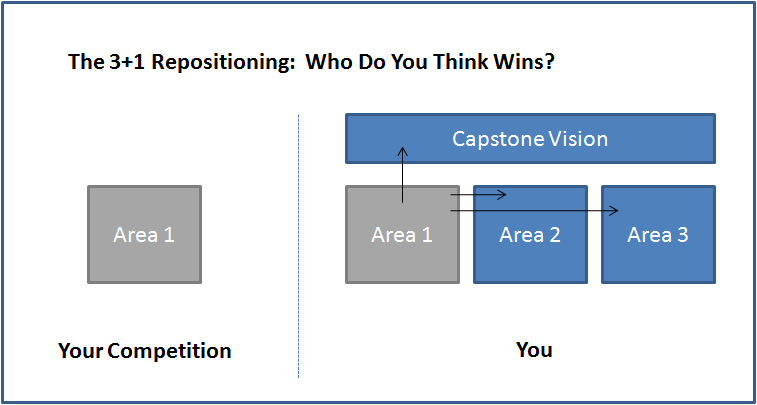
 This is our current offering and it includes area 1 (which the other guy is pitching), but also areas 2 and 3, and the vision for our company is not just about having the best area 1, but instead to pursue a capstone vision that includes areas 1, 2, and 3.

Ceteris paribus, who do you think wins?  You do.  Why?  Because you completely enveloped the other guy’s message.    You neutralized him on area 1, you one-upped him in areas 2 and 3 (even if your current offering is anemic on an absolute basis), and then you made the customer feel both more aligned with and safer buying from your company because you are pursuing the bigger vision.

I call this a 3+1 repositioning.

I did my first 3+1 repositioning  back in about 1989 when I launched Ingres 6.3.  Prior versions Ingres were just for data management, but with release 6.3 we not only improved data management, but added knowledge management and object management capabilities and introduced the vision of an intelligent database system.  So area 1 = data management, area 2 = knowledge management, area 3 = object management, and the capstone vision was the intelligent database.  While it was a well-executed launch, it was a long time ago, Ingres had many other problems, and the ending wasn’t terribly happy.

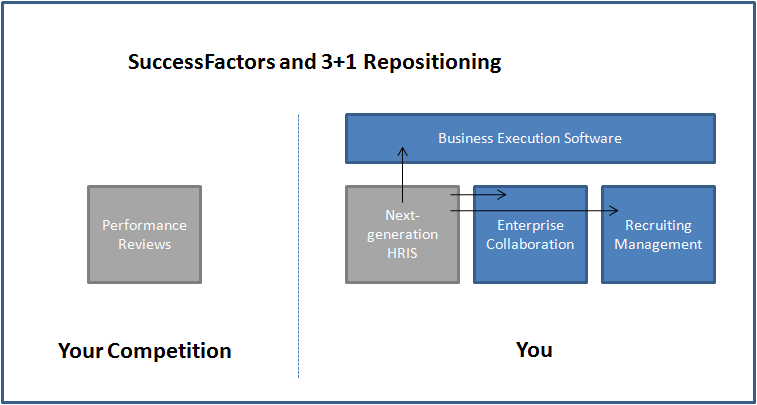
So let’s look at some more recent examples.  SuccessFactors (where Albright was CMO and GM for several years) started out as a SaaS provider of performance reviews. How do you broaden that vision?  Well let’s look at what they say now:

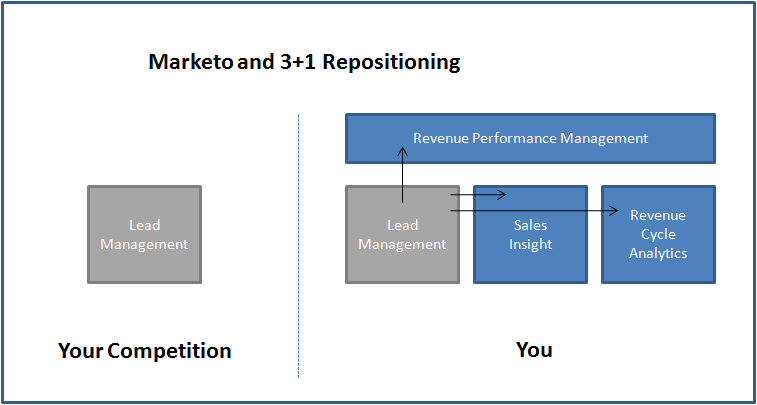
Now let’s take a look at Marketo, a firm that I have traditionally thought of as about lead nurturing and incubation.

The magic of the 3+1 repositioning is:

  • It paints a broader vision, enveloping your competition
  • It provides a simple, memorable three-point message.  (Heck, I launched Ingres 6.3 more than 20 years ago and still remember the message!)
  • It lets you call higher, getting access to more power within the organization
  • It positions your company as a thought leader, someone defining the future of the market
  • It takes for granted your ability to neutralize any features du  jour in the core area.  (Oh, yes, we’re committed to having top-end lead management, but that’s just one part of the picture.)
  • It rallies your company, providing a North star towards which everyone can navigate.

The perils of a 3+1 repositioning are:

  • It can’t be done solely are a marketing exercise; it must be a company strategy and some resources must be invested in areas 2 and 3.
  • You can easily oversell areas 2 and 3, ending up with disappointed customers.  Remember the bear joke:  you just need to run faster than the other guy, so don’t overset expectations.
  • It can make your accountants nervous because there is a distinction between buying today’s product and buying into a (disclaimed) future vision and buying tomorrow’s product.  The latter tends to have negative revenue recognition issues.

In the end, I am a big fan of this 3+1 formula and encourage marketers everywhere to keep it in your toolbox.

The Silicon Valley Strategic “Pivot”

The first time I heard the word “pivot” in the context of business strategy was about nine months ago.  As a student of language, my ears perked up when I heard it.  I remember thinking, “pivot … interesting, haven’t heard that one before, … strong buzzword potential, … nice metaphor, with one foot stationary and the other moving.”

Silicon Valley being Silicon Valley, with more fashion around language than clothing, today you hear it all the time.  Some sample usage:

  • “Yeah, dude, we had to pivot after our A-round, but after that we really got traction.”
  • “I think you know like, we’re running on our 401k round, just trying to figure out the core product, then we’ll expose it to the market, through a pre-alpha and pivot from there.”
  • “Like, you know, every startup needs to  pivot like two or three times before locking-in on its final strategy.  That’s the nature of innovation.”

Extending the metaphor, one wonders in the last example if your board can call the CEO for strategic traveling.  

Despite my general buzzword aversion, I like the pivot metaphor precisely because one foot is stationary.  A complete strategy change is therefore not a pivot but a traveling violation because you entirely abandon the old strategy as opposed to changing direction in a way that leaves one foot in the old strategy and one foot in the new.

I also like the pivot metaphor because I agree with the idea that from inception to $100M that a company will need to pivot and probably a few times.  (Think pivoting multiple times in a game, but not on one ball.)  That truly is the nature of innovation and Silicon Valley companies do it all the time.

The two interesting questions then become:

  • How do you know if you’re traveling vs. pivoting?
  • How you know if the pivot worked?

I answer the first question by evaluating the degree of continuity between the old and the new strategy.  I’d evaluate the second question by the revenue and margin contribution of the old strategy vs. the new one.  If the old strategy is driving all the revenue, then you may have pivoted, but it’s not working.  If the new strategy is driving the lion’s share of revenue and margin, then — and only then — have you done a successful pivot.

What the CEO Really Thinks of Marketing (And 5 Things You Can Do About It)

As a marketing guy turned CEO, I have the relatively rare experience of having seen marketing from inside the organization as well as from above it.  Yesterday, the SV Forum Marketing SIG invited me to give a presentation where I discussed marketing from the CEO’s perspective.

I’ve embedded the slides below for your viewing pleasure.

Why Palantir Makes My Head Hurt

While I’ve blogged before about Palantir Technologies (e.g., Beware the Spectacular B-Round Valuation), this will probably be my last post about them because, since leaving MarkLogic, I am no longer terribly involved in the Intelligence Community space nor engaged against them as an indirect competitor.

I initially became interested in Palantir for several reasons:

Part of the marketing was making controversial claims, such as:

  1. We have no sales.  (e.g., at minute 5:40)
  2. We have no marketing.
  3. We have no services.  (Our field technical staff aren’t consultants, they are forward-deployed engineers.)
  4. Positioning as a billion-dollar company when sales were probably in the tens of millions.
  5. Talking about valuation on funding rounds.

Now, as a credibility-is-key marketer, these kinds of claims bug me at two levels:  first, that people would make them and second, that the media would report them.  Here’s my take on these 5 claims:

  1. Whether you want to call it sales or not, someone meets customers, talks about what your software does, discusses how to price it, negotiates and signs a contract.  In the normal world, that is called sales.
  2. Whether you want to call it marketing or not, someone made the website, spent money to sponsor a party, setup the Charlie Rose interview, and designed and paid for the DC subway ads.  In the normal world, that is called marketing.
  3. Whether you want to call it services or forward-deployed engineering, you are sending smart people with engineering and computer science degrees to customers’ sites and helping them solve problems using your software.  In the normal world, those tasks are called pre-sales engineering and consulting, depending on whether they happen before or after a sale.
  4. The standard way, in the real world, to refer to a company’s size is by revenue.  The one and only time I frequently heard people referring to company size by market capitalization (or valuation) was during the Internet bubble.
  5. While this is primarily a style issue, most companies do not disclose valuation on venture funding rounds.  I believe those who do are trying to generate hype.  (And for a company that insists it has no marketing to want to generate hype is doubly irritating.)

At the big picture level, Palantir reminded me of MicroStrategy:  big claims and hype, DC-centricity,  elite school hiring focus, youth focus, a large field technical team, and a work hard / party hard ethos.

At this point I should admit to having some scars from having run marketing at Business Objects during MicroStrategy’s rise.  Let demonstrate what a day in life looked like:

  • Dave, MicroStrategy says their mission is to “purge ignorance from the planet.”  How come we can’t say anything visionary like that in our mission?
  • Dave, Michael Saylor says he’s going to build a modern-day Versailles just outside of DC.  How come our CEO never says stuff like that?
  • Dave, MicroStrategy says they’re building a service where people will wear tiny microphones in their ears and it will notify them if their house catches fire.  How come we don’t have product vision like that?
  • Dave, MicroStrategy just did a $52.5M deal in an industry where average sales prices are $250K and a big deal is a few million.  Why can’t we do huge deals like that?
  • Dave, Michael Saylor says that there will be riots if his software doesn’t work and that this year people will die — literally — because they didn’t buy his software.  How come we’re not mission-critical like that?

To which for several years I had to say “it’s all bullshit, it’s all bullshit, it’s a barter transaction and they’re double counting, and it’s all bullshit.”

It turns out being a naysayer isn’t fun work:  for three years you sound like a whining, doubting-Thomas constantly on the back foot, constantly playing defense and then one day you’re proven right.  But there’s no joy in it.  And the naysaying doesn’t help sell newspapers so you don’t get much press coverage.  And, in the end, all people remember is that “MicroStrategy was pretty cool back in the day” and “Dave’s a grump.”

It was during this period that I got interested in Corporate Cults because MicroStrategy struck me as one.

  • Hire young people with similar profiles from the best schools (e.g., MIT)
  • Work them long hours
  • Isolate them from friends and family
  • Blur distinctions between work life and personal life (e.g., company cruise, work hard / play together)
  • Tell them they’re the best
  • Tell them naysayers don’t get it

Six steps to make MIT engineers cult members.  Thus, in addition to other MicroStrategy parallels, Palantir struck me as a corporate cult.  Kind of a Logan’s Run (where no one is over 30) meets the Apple 1984 commercial (conformism à la the black jackets).

Since I left MarkLogic in January, Palantir got tangled up in the HBGary WikiLeaks mess (proposal here), generated some positive press in Forbes, and raised a $60M round of financing at a valuation rumored to be as high as $3B, bringing the total invested capital to an estimated $175M, a lot of money for an enterprise software company.

This begs the perennial question of “if they’re doing so well, then why do they need so much cash?”  While there are potentially both good and bad answers to that question, my guess is the answer is roughly:

  • Because they can raise it at huge valuations for relatively little dilution.  (Peter Thiel may be a huge help on this front.)
  • Because they intend to spend it to continue hiring and perpetuate the lavish-spending culture and hype machine.
  • Because they are executing a go-big or go-home strategy that is cash intensive and will, they hope, result in a huge exit valuation.

But why does Palantir make my head hurt?

  • Because, despite my general skepticism, I believe they get some things very right.
  • Because, despite their intent, they may have created a new kind of company.

Because I can be perceived as a Palantir detractor, I’ll say it again:  Palantir gets some things very right.  Which things?

  • They hire brilliant people.  They deliver on the hype in this department.
  • They solve hard problems.  I hear customers are generally quite happy.
  • They solve the whole problem.  They don’t just drop software in your driveway and run away.
  • They aren’t afraid to ask for huge checks, order of magnitude in the tens of millions.

Personally, I don’t buy the argument that all field technical staff are “forward-deployed engineers” as opposed to pre- or post-sales consultants.  But I would believe that you can hire better people by telling them they’re engineers as opposed to pre-sales consultants.  And, I could even believe that someone could convince himself — if perhaps not his accountants — that field technical staff are not customizing an application but instead developing a product.

That last point is important.  Why?

  • If field technical staff are engineers, then the associated revenue is presumably license fees and the cost is R&D.
  • If field technical staff are consultants, then the associated revenue is services and the cost is COGS.

Why does this matter?  Because most software company boards and investors see the world in a pretty black-and-white way:

  • License revenue is good.  Services revenue is bad.  (Largely because gross margins run 98% on the former and 20-30% on the latter).
  • R&D expense is investment and ergo good.  Cost of goods sold is bad.

Almost all Silicon Valley boards will want an emerging enterprise software company to run with a consulting business that’s no more than about 20% of total sales.  In practice this means a company can have at most about 1.5 consultants (pre- and post-sales) per salesperson.  Any work that can’t be done either as R&D investment or by that small consulting team needs to get handed off to partners.  This means the vendor loses control over customer success (which customers don’t like) and the vendor doesn’t end up owning all the IP required to solve the whole problem.

Now, my guess is that Palantir’s board doesn’t care about any of the preceding four paragraphs, probably because of cult arrogance:  we don’t care what pedestrian accountants say because we are changing the world and building the ultimate set of products.  Accounting, schmaccoutning.

This works well as a private company, particularly if you don’t plan on going public.  But the constraint on consulting growth hamstrings most enterprise software companies forcing them into a component-orientation, a drive-by license sales model, and a disregard for customer success — the traditional negatives that helped the drive the SaaS movement.

But, regardless of the reason, Palantir is a different type of company.

  • Like a system integrator (SI), they have a small sales force, a large field technical staff, solve whole problems, and ask for big checks.
  • Like a software company, they hire world-class engineers and try to capture everything in product.

Is Palantir an enterprise software company with no sales, marketing, or services (as they would like to believe) or are they the first SI to figure out how to build a world-class software business as most SI’s aspire?

You can argue the difference is just semantics, but I’d argue the latter.