Strategic Thoughts on Finding a Job in Silicon Valley

While I know that reading the newspaper — with high unemployment, record budget deficits, and drastic spending cuts  — might make you want to go back to bed in the morning, from my experience there is plenty of positive excitement happening in Silicon Valley right now.  Venture capital (VC) is the engine of Silicon Valley, VC investment is strong, and entrepreneurship seems to be alive and well.

After finishing up a six-year run at my last company, I am currently in the process of looking for my next opportunity.  Since I’ve been out-and-about and thinking quite a bit about the job search process, I thought I’d share a few of my learnings along the way.

  • Opportunity trumps execution.  Seek companies that face large and/or obvious market opportunities.  I have always done best when joining companies where I am convinced that everybody needs one.
  • Team trumps position.  Being on the right team is more important than the particular position you’re asked to play.  Positions change over time.  Don’t pick a director title at a weaker company when you could have made five times the money, had five times the fun, and made five times more valuable networking relationships as a senior product manager at a stronger one.  Business card narcissism can be a road to nowhere.  See the bottom of this post for some fun math in this regard.
  • Think IPO-zone, not pre- or post-IPO.  Most people draw a bright line at a company’s IPO, acting as if the good part of the movie ends there.  In reality, an IPO is like high school graduation — it is the beginning, not the end.  If you can join a quality company in the IPO zone (e.g., 12 months either side of an IPO), you are likely to do very well.  Which side of the IPO line matters far less than whether company is reasonably in the IPO zone.  (Thanks to Jerry Held for helping me reframe things this way.)
  • Know thyself.  Get a sense for what kind of environment you will realistically like and then use interviews to validate or invalidate that view.  For example, I’ve talked to companies ranging from 3 to 300,000 employees, and I can say that I most enjoy the 100 to 10,000 range.  Yes, that’s two orders of magnitude, but I’ve talked across five!
  • Have a positioning.  I have worked hard to keep my positioning “strategic marketing guy.”  You might think I would have dumped “marketing guy” in favor of “CEO” during the past 6 years, but I deliberately did not for two reasons:  I thought it would needlessly close doors for  SVP/ GM jobs at larger organizations and I thought it was inaccurate.  In the end, nobody grows up a CEO; we all grow up in some function that helps define who we are.  Yes, I have been a successful CEO, think I’m process-oriented, and think I’m great at running and scaling operations — but deep down I’m an analytical, strategic marketing guy from New York.  It’s essence vs. experience:  positioning is about essence.
  • Remember that like sales, it’s a volume game.  I have looked at over 40 different opportunities in one month and keep finding new ones every day.  I’ve done this through networking with peers and venture capitalists, cultivating recruiter relationships over the years, and to a lesser extent by leveraging social media.  At some point you will pick a new role and you will make a more informed choice if you have really beaten the bushes while searching.
  • Be picky.  Life’s too short and we spend too much time at work to work with people we don’t genuinely enjoy.  For me, that means finding smart, direct people who are just a little bit crazy.  For you, it probably means something else.  But all of us should (politely) avoid bossholes (or boardholes) who ruin things for everyone.
  • Be nice.  A CEO friend has a board member who is fond of saying “friends come and go; enemies accumulate.” That’s great advice to remember both in day-to-day work life as well as when you’re out looking for a new opportunity.  It’s a small valley and you want to accumulate as few enemies as possible during your time working in it.

Bonus:  Some Fun Employment Math
First, let me make a table that demonstrates two rules of thumb:  salary increases 30% with each level in an organization and equity increases 4x.  Applying these two rules generates a reasonable approximation of a B-round startup, below.
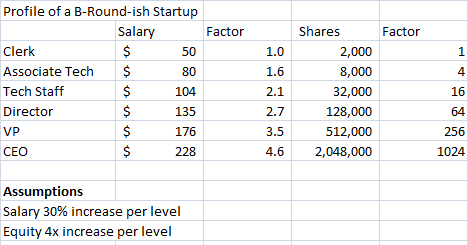
Note that while the CEO makes 4.6 times a clerk’s salary, he or she makes 1024 times a clerk’s equity.  That is the argument for being high in an organization.  But we have to be careful not to apply that logic blindly.

Let’s take an example.  Say you’re good enough to get a VP job at a good quality startup.  That might come with 1% equity grant.  Now, let’s say you’re talking to another, better-quality startup and they want to make you a director with a 0.3% equity grant — but, because you’re a hot candidate you can talk them up to 0.5%.  Let’s say the stronger company is growing 80% and the weaker one 30%.
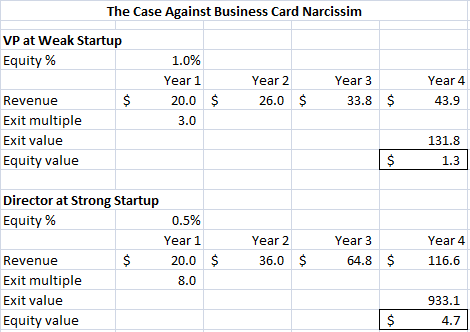
You make 3.5 times as much money with the smaller grant, and smaller title, at the stronger startup.  Note that even if you can’t talk up the grant to 0.5% and only get the 0.3% initially offered, you still make over twice the money at the stronger company.  Which company will look better on your resume in the future?  And, if you’re good, who’s to say you won’t end up a VP at the stronger company in year two?

Hopefully this demonstrates how company opportunity trumps job title — i..e, that being on the right team is more important than the position you’re initially asked to play.

Leo’s Pawn to King Four: HP To Acquire Vertica (Updated)

HP today announced that they will acquire data warehouse and analytics platform provider Vertica of Billerica, MA.  Cowen and Company estimated the price at 5x revenues, estimating that Vertica did $40M in 2010 revenues, suggesting a valuation of $200M which I find low.  Frankly, I wouldn’t be surprised if it were twice that given the hotness of the space, the gradual opening of the IPO window, and the opportunity cost for Vertica of forgoing independent growth. See the bottom of the post for more math fun and guessing.

[Update:  I have now heard valuation guestimates including “over $300M” and “north of $500M” so at this point I’m starting to get confused — rumors around valuation usually converge, not diverge.  Yesterday, the 451 Group said they believed the price was $275M up-front with up to a $100M earn-out that can be earned over time through performance.  This makes sense  to me both in terms of valuation range and in terms of the confusion about valuation.]

This move follows on EMC’s July acquistion of Greenplum, rumored to be in the $400M range.

The move marks Leo Apotheker’s first big move as CEO of HP and — finally — gets HP into the data warehousing and analytics market in a real way.  (Let’s not talk about NeoView which, for whatever reason, was never taken seriously in the market.)

Many folks, including me, thought HP missed their big chance to enter the DBMS and data warehousing markets by failing to scoop up Sybase back in May, which SAP did for $5.8B.

The move is probably a change in direction for HP’s software head, Bill Veghte, who joined HP in May from Microsoft, where he had spent his entire career after graduating from Harvard, and where he was most recently responsible for shipping Windows 7.  Based on his background, I suspect that Veghte was going to head into data center, security, and infrastructure (a la the $1.5B acquisition of ArcSight in September).  Perhaps Leo’s moves into data warehousing, analytics and presumably one day — enterprise applications — will complement, rather than replace, that more infrastructure-oriented strategy.

Yesterday, The Mercury News ran an interesting piece on HP’s new non-executive chairman of the board, Ray Lane, who was appointed at the same time as Apotheker, and who has already taken major steps to reshape HP’s board.  Lane was instrumental in steering Oracle out of a financial crisis in the early 1990s and driving their growth throughout that decade.

I suspect this is HP’s opening move.  There will be many more to come.

Guessing Vertica’s Size:  $25 to $35M-ish
LinkedIn says Vertica has 96 employees.  For West Coast companies this figure is usually quite accurate; let’s assume it is for Vertica.  “Normal” productivity of $250K to $300K/head implies revenues of $24M to $33M.  LinkedIn says Vertica has 36 employees in sales.  If one of three of those are quota carriers, then you have 12 quota-carriers at “normal” productivity of $2M implying $24M.  Alternatively, if you assume 15% of a enterprise software company’s headcount is quota-carrying that implies 15 quota carriers at $2M each yielding $30M.  All of this is very back-of-the-envelop and breaks under high-growth rates.

Nevertheless, I’ll guess they are $25 to $35M in revenues, suggesting that a $200M exit would be 6-8x revenues and a $375M exit would be 11-15x, basically validating the possibility of $200M+ up-front price with a performance-based earn-out.

A Note to the CEO: Drive the Board of Directors

I remember during my first year at Cal we’d sometimes see a local band, Psycotic Pineapple [sic], who performed a song entitled “The Devil has Work for Idle Hands.” Every time they sang the chorus, audience members would hold their arms above their heads and dangle their crossed hands as they danced. Keep that scene in mind as we head into today’s post about CEOs, boards of directors, and the relationship between them.

While I don’t claim to have any particular gift in “managing” a board, I have learned a bit over the years by being a CEO, sitting as independent director, and chatting with other CEOs, venture capitalists, and independent board members.

Before discussing the board/CEO relationship, let’s define a framework first.

What Is The CEO’s Job?
The CEO’s job is to run the company, set culture, and manage the relationship with the board.

Setting culture means defining, communicating, and living the norms you want to establish inside the organization.  Running the company means setting strategy, putting the team in place to execute that strategy, letting that team do its job, and keeping everyone communicating along the way.

What Is The Board’s Job?
I’ve often quipped that the board’s job is to meet 4-6 times per year to decide if it should fire the CEO.  While overstated, it captures my belief that the board should have no operating responsibility because the board’s job is governance.

The board should question the management team on operations and discuss the team’s answers.  The board should oversee and approve financial audits, operating plans, compensation plans, bonuses, officer appointments, stock option grants, financing rounds, long-term obligations (e.g., leases), and M&A transactions.

Why Do Boards Exist?
Let’s go back to business school 101.  From first principles, boards are needed because of absentee ownership — i.e., when the owners of a company are not the operators of a company they hire agents (all employees, including the CEO) to run the company for them.  To oversee those agents, and protect against agency problems, the company creates a board of directors.

Note that in Silicon Valley startups, the absentee owner assumption is less true than in corporate America because ownership is both concentrated and well represented on the board.  Founders and VCs together might own 70-80% of company and sit together on the board.   While the VCs are absentee in the sense that they don’t work at the company, the founders typically do.

Governance = Discussion plus Approval
I’m not a lawyer, but as far as I can tell, governance is about two things:  discussion and approval.  For example, when people first see a company’s board minutes, they are typically shocked because they appear devoid of content.

On January 5, 2011, persons A, B, C, and D from the board of directors met at 10:00 AM at the Company’s headquarters in Palo Alto, California.  Mr. Smith, the VP of sales presented the sales results for 4Q10 and the forecast for 1Q11 including a discussion bookings, revenues, forecast accuracy, lost deals, and pipeline coverage.  The board asked numerous questions of Mr. Smith and a vigorous discussion followed.

But they’re not saying what the forecast is?  Or who asked what question?  Or what the sales results were?  All the facts are missing!  But they aren’t.  The facts the law cares about relate to whether the board did its job.  It convened.  It met with management.  It asked questions.  It had a vigorous discussion.

The content of the discussion matters less, primarily because in business you have the right to be wrong.  It’s not a crime to start a company that sells three-headed elephant dolls; it’s just a bad idea.  The law isn’t going to go anywhere near trying to decide what’s a good idea or a bad idea – that is left to business judgment.  The law wants to ensure that oversight is happening — that the board is meeting and the business is being discussed.

While it might seem quaint, this notion of discussion is so strong in the law that board decisions made without an opportunity for discussion (e.g., not at a duly called meeting, but over an email chain) must be made unanimously.  (As an aside, misunderstandings about when such resolutions became effective were a part of the option backdating scandals of the 2000s.)

The Direction Paradox
While discussions, challenges, advice, and questioning are always good, when boards give operational direction (i.e., “you should do X”) they risk creating a paradox for the CEO.  It’s easy when the CEO agrees with the direction and in that case the direction could have been offered as advice and still would have been heeded.

It gets hard when the CEO disagrees with the direction:

Case 1:  If the CEO follows the direction (and is correct that it was wrong), he or she will be fired for poor results.

Case 2:  If the CEO fails to follow the direction, his or her political capital account will be instantly debited (regardless of whether eventually proven right) and he or she will eventually be fired for non-alignment as the process repeats itself over time.

In case 1, the CEO will be surprised at his termination hearing.  “But, but, but … I did what you told me to do!”  “But no,” the board will reply.  “You are the CEO.  Your job is to deliver results and do what you think is right.”  And they’ll be correct in saying that.

Once caught in the paradox, weak CEOs die confused on the first hill and strong ones die frustrated on the second.

Because the paradox is only created when boards give specific direction (i.e., “you should do X”), I think boards should generally refrain from so doing, and prefer questioning, challenging, brainstorming, and advice-giving to directing.

A Wacky Idea for Resolving the Direction Paradox
As a gamer, I have a simple but admittedly impractical idea for solving the paradox.  The CEO and the board each start with three credits.  Each time there is a disagreement on a major issue if the CEO goes against the board he instantly burns one credit.  If he is eventually proven right he gets 3 additional credits back.  The system separates major from minor conflict (“are we talking credits here?”), empowers to the CEO to make the decisions he/she believes in, reminds the CEO that going against the board is costly, but rewards him/her for the gumption to do so if they are eventually proven right.

A Better Idea for Managing the Whole Situation:  Drive the Board!
But there is a better way to handle the problem.  Why does the direction paradox happen?  I think for many good reasons:

  • Board members want to be helpful
  • Board members want to make an impact
  • Board members want to participate, not just sit and experience death-by-PowerPoint at every board meeting

In the past 6 months, three different VC ecosystem types have told me something akin to the following:

“You know, I love Joe, the CEO of company X.   You know why?  Joe is in charge.  Unlike most CEOs, Joe sends out his board deck 4 days early.  Then he calls me to make sure I’ve reviewed it and to ask if I have any questions.  So he’s both holding me accountable for doing my job and he’s speeding up the (boring) operational review part of the board meeting.  So the board meetings largely become discussions about important topics.  They don’t always take the full three hours, so sometimes I get to leave early, but they always energize me and let me contribute.  Heck, the craziest thing about Joe is that he’s got me working for him.  I leave the board meeting with 10 action items that can help the company and Joe calls me the next week and the week after to make sure I’m doing them.”

Joe has clearly taken control of the situation.  Joe knows the board has energy and wants to help.  And Joe learned from Psycotic Pineapple that idle hands are dangerous.  So Joe channels the board’s energy the way he sees fit, controls the situation, engages the board, and wins their esteem in the process.  That is clearly a better way to manage the situation.

Framing the Board Relationship
The other thing that Joe got right was framing the board relationship.  Many, many CEOs see their board as a tax, a group that takes time, saps energy, and distracts from running the operations of the company.

Joe has reframed things:  he has framed the board not as a tax, but as a value creation partner.  This is another smart move that sows the seeds for a healthier long-term relationship among the board, the CEO, and the whole executive team.

And if you don’t get the framing of that relationship right, your board might end up singing one of Psycotic Pineapple’s top songs:   I Wanna, Wanna, Wanna, Wanna, Wanna, Wanna, Wanna Get Rid of  You.

A Note to Public Relations: Be Credible and Check Your Math

I stumbled into this press release during my morning reading (ParAccel Triples Revenue, Doubles Customers and Appoints New Executive Team in 2010) and felt an overwhelming and immediate need to use it as an educational example in public relations (PR).

CAMPBELL, Calif.–(BUSINESS WIRE)–ParAccel, Inc., provider of the world’s fastest analytic database, today announced that it achieved record financial performance in 2010 with 300 percent revenue growth over 2009. The company doubled its customer base with key enterprise wins, launched ParAccel Analytic Database (PADB) 3.0, and continued to expand partnerships with leading platform, storage and analytics vendors. To keep pace with its growth, the company hired key new executives and moved its corporate headquarters to a larger facility located in Campbell – the heart of Silicon Valley.

Here are my comments on this release:

Make supportable claims. The “world’s fastest analytic database” claim strikes me as both unsupported and unsupportable.  Different databases are good at different things and there are many analytic database competitors in the market.  It is not credible that any one DBMS could be fastest at all of them.  But this is supposed to be a PR , not a product marketing, post so I won’t drill further.

If you’re going to talk growth, then provide real numbers.  Tripling revenue sounds very nice, but from what to what?  Many private companies now make these number-free growth claims, but they’re hard to take seriously.  Either release real numbers or avoid talking about growth.

If you’re going to talk about growth, do the math correctly.  Tripling revenue does not equal 300% growth. Think about it:  100% growth = doubling revenue, 200% growth = tripling revenue, so 300% growth = quadrupling revenue.   This is a serious credibility blunder and sadly it’s not uncommon.  Get a finance person to review press releases with numbers in them.

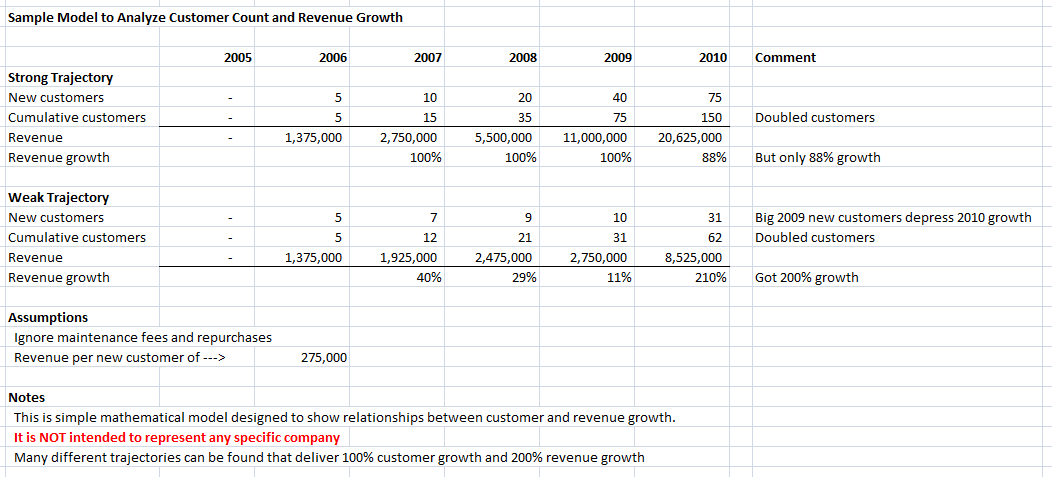
If you’re doubling customers and tripling revenues, then you’ve got me asking questions.  People will cross-check your numbers, particularly when you’re providing only pieces of the puzzle and have already made one math blunder.  I think they mean to say that they tripled annual revenues and doubled the cumulative size of the installed base (i.e., number of customers).   Since I’m not sure what to make of that, I made a little model in Excel.  I think what the model tells me is that, ceteris paribus, when you are on a strong growth trajectory doubling the installed base is not enough to triple revenues.  I’m sure there are better ways to analyze this, but that’s not my point.  My point is, as a marketer, when you are providing only pieces of the puzzle you are hanging yourself out to dry if those pieces are inconsistent or provide a clue to a less rosy bigger picture.

By the way, my guess, based on playing with the model below, is that the company had  a weak trajectory in 2006-2009 and then had a nice 2010.

“The data warehouse market, and specifically the market for high-performance analytic databases, is growing and evolving at an exponential rate;

Don’t say “exponential growth” if you don’t know what it means.  I love the data warehousing market.  It is large, growing, and healthy — but it is not growing exponentially.  Exponential growth has a precise meaning.  The data warehouse market is growing at a 12% (linear) rate and will $13.2B by 2013.  That’s huge and wonderful already.  Saying the growth is exponential just damages credibility and undermines an otherwise very strong message.

Say “Appoints New Executives,” not “Appoints New Executive Team.” The new CEO joined in August, so that’s not news.  The company has appointed a new COO, CMO, and VP of International.  Those are important roles and should be announced.  But the headline makes it sound like the board blew out the entire executive staff and replaced them in one shot.  This is not only a non sequitur (i.e., “we’re doing so well we fired everyone”), it’s also inaccurate.

“With this new, energized executive team in place, strategic partnerships with NetApp, … and leading business intelligence vendors, combined with … ParAccel is poised for an even more impressive 2011.”

Be careful in expectations management. While I just love the “energized” comment  (i.e., were the old guys tired?) my real issue is that the company is saying that 2011 will be better than 2010.  They shouldn’t say this unless they plan to more than triple revenues in 2011 and more than double the installed base.  Logically, anything less would then be a disappointment.

To keep pace with its growth, the company hired key new executives and moved its corporate headquarters to a larger facility located in Campbell – the heart of Silicon Valley.

Be credible.  Unless I somehow misplaced Bill and Dave’s Garage, Palo Alto is the heart of Silicon Valley. In 25 years in and around Silicon Valley, never before have I heard Campbell referred to as its heart.  C’mon.

Reminder:  see my FAQ for relevant disclaimers.

Perpetual Money vs. Perpetual License: Subscription, SaaS, and Perpetual Business Models

I had breakfast the other day with a software entrepreneur.  When I asked if his company was on a subscription or perpetual model he said:  “we should kill the guy who invented the perpetual license — I’m on the perpetual money model, subscription all the way.”

Having worked largely in perpetual license firms, I admit there are many downsides to the perpetual model.  Companies on perpetual models typically:

  • Have more volatile revenue performance due to a relatively smaller annuity “keel” on the business (in the form of maintenance renewals).
  • Are more exposed to end-of-quarter shocks driven by backend-loaded sales.  (Most software companies get 70%+ of their orders in the last month of the quarter and most of those in the last week.)
  • End up with “drive-by sales” cultures because sales reps are paid only on license sales and not on maintenance renewals.
  • Have less customer-success-focused cultures because sales reps care about customer success only to the extent they see potential follow-on license business in the short term.

That said, there are many ways to mitigate each of the above points and all of the world’s largest software companies, such as Oracle and SAP, still do most of their business on a perpetual license model.

Over the past decade companies like Salesforce, NetSuite, and SuccessFactors have pushed the software as a service (SaaS) model where the vendor both runs the software and bills on an annual subscription basis to use it.  While the SaaS model cut its teeth in applications like sales force automation, vendors are increasingly selling platform as a service (PaaS) offerings as well, such as Amazon Web Services, Google AppEngine, or Force.com.

Clearly SaaS interest and hype remain strong.  Salesforce is trading at 100x FY11 earnings.  Bankers have told me that the IPO bar for SaaS companies is $75 to $100M in revenue, while for perpetual companies it might be 1.5 times higher than that.  A recent Software Equity Group report pegs the median enterprise value (EV) of of SaaS companies at 4.9x revenues, almost double the 2.7x revenues for perpetual companies.  On an EV/EBITDA basis, it’s even more dramatic with SaaS companies at 44x and perpetual ones at 13.6x.

Given all this, I thought it would be fun to make an Excel model that concretely demonstrates some of the differences between  perpetual and SaaS software companies.  To do so, I’ll first model a fictitious, red-hot software startup on a perpetual basis.  Then I’ll remodel the same company on a SaaS basis.  Then we’ll play around with the models and see what we find.  (For Excel geeks, my model is here; you’ll need to download it.)

To make my model, I started with bookings for the perpetual company and hard coded $5M in the first year on a reasonable ramp.  Then I made a set of reasonable assumptions (for a hot startup) that drove the rest of the model:  100% license bookings growth, a 20% maintenance rate, a 90% maintenance renewal rate, a 50% rate of professional services organization (PSO) services bookings relative to license, and a bookings-to-revenue conversion rate of 85% for PSO in the subsequent quarter.  To keep things simple, I didn’t model months, I didn’t model cash, I assume all bookings happen on the last day of the quarter, and I assume all license revenue is immediately recognizable.

Then I remodeled the company on a SaaS basis.  The most important assumption to make here is labeled “subscript as % of license” – i.e., if someone was ready to pay 100 units for a perpetual license to use something, presumably they want to pay some fraction of that for a one-year subscription to use it.  (I’ll call this F for fraction.)  For the initial model, I assumed F=50% which is arguably aggressive.  I kept the renewal rate at 90%.  I assumed that configuring a SaaS system requires less PSO than customizing a perpetual one, so I assumed a 50% PSO bookings rate relative to the subscription (or 25% of the total PSO required from the perpetual vendor).  I assumed subscriptions were one year and revenue was recognized ratably over the year and that all orders were received the last day of the quarter.

When you make these two models, here is what you find:

In year 4,

  • The perpetual company is 2.2 times larger than the SaaS company at $62M vs. $28M
  • The perpetual company is growing at 103% and the SaaS one at 115%
  • The perpetual company has an 8% “annuity keel” in the form of maintenance renewal bookings while the SaaS company has a 33% annuity keel in subscription renewal bookings.  (You can’t see this in the picture, but it’s in the model.)

Valuation and The Fallacy of Equivalence
Using the standard multiples above, let’s see what each of our companies is worth:

  • The $62M perpetual company is worth 2.7 x $62M = $167M
  • The $28M SaaS company is worth 4.9 x $28M = $137M

Simply put:  the stock market works.  With only a 20% difference in valuation between what ostensibly seem like two very different companies you can see that higher EV/R multiple for SaaS companies is almost completely offset by the increased difficulty of building a SaaS revenue stream.  Wall Street “sees through” the differences in the models and values the companies roughly equivalently.  Put differently, SaaS companies fetch 1.8x the revenue multiple of perpetual companies because they are worth 1.8x the revenue multiple of perpetual companies.

During the past few years I have spoken with several CEOs who transitioned their companies from perpetual to SaaS.  The standard word is that it takes 3 years to make the transition and the transition must be a top-three company goal for that entire period.  While there are many good reasons for perpetual companies to consider moving to SaaS models, valuation isn’t one of them.  Yes, you get roughly twice the EV/R multiple, but building the R (revenue) stream is just about twice as hard.

Max Schireson calls this the fallacy of equivalence.  If gold is worth twice silver and assume we have an equal amount of gold as we had silver then we are worth twice as much.  The fallacy is that gold is twice as hard to come by as silver so you can’t assume equal amounts — see the huge revenue delta which is largely driven by the SaaS company’s need to spread revenue over 4 quarters.

Taking a Bad Quarter
Let’s look at how each company takes a bad quarter by assuming that we hit 70% of our bookings target in 3Q13 — doing only $4M in perpetual license bookings (cell P8) and only $2.25M in new subscriptions (cell P27).

  • In the perpetual company 3Q11 revenue drops from $8.7M to $6.7M, the year/year growth rate drops from 105% to 58%, the stock is presumably crushed  by 80%, and the CEO summarily fired.
  • In the SaaS company 3Q11 revenue is unchanged. (Recall I modeled all bookings on the last day of the quarter.)  4Q11 revenue drops from $4.5M to $4.0M, 1Q12 drops from $5.8M to $5.6M, and the following two quarters also take ~$100K to $200K hits.  The stock drops 20% because 4Q11 guidance is dropped but the company appears in control of its business and no one is fired.

Hitting The Flat Part of the Market
Now let’s examine both companies assuming that the market goes flat in 2014 (i.e., that 2014 license bookings / new subscriptions do not grow over 2013, cells S8-V8 and S27-V27).

  • Our perpetual company sees 2014 revenue growth slow from 106% in 2013 to 17% in 2014.  Revenue drops from the plan of $62M to $35.9M.  The CEO is fired for flying the company off a cliff.
  • Our SaaS company sees 2014 revenue growth slow from 141% in 2013 to 76% in 2014.  Revenue drops from the plan of $27.9 to $22.9M.  The CEO is commended for successfully managing the company through a tough transition.

What going on here is simple:  volatility is being damped — for better and for worse — by the SaaS company’s need to spread revenue over the four quarters following the booking.  That makes it harder to grow the revenue stream quickly.  It also makes it harder to change once established.

Sales Compensation
One tricky issue in the SaaS model is sales compensation.  In a typical perpetual company total sales commissions (at all levels) add up to around 10%.  So, for 100 units of revenue, you pay 10 units in commissions.  Sales reps are usually not paid on the 20 unit annuity stream of maintenance renewals.

In SaaS model, we have a conflict.  If you assume the annual subscription fetches 50 units (i.e., if F=50%):

  • The company wants to pay 10% of 50 = 5 units in year 1 and then pay little or nothing on the renewals.
  • Sales want to argue either that [1] the deal is worth 150 units over three years and compensation should be 15 units or [2] (if they’re good at math) 300 units if you look at the stream’s terminal value (factored by renewal rates and discounted by 8%) and thus sales compensation should be 30 units.

So what do you pay:  5, 15, or 30 units?  I believe that most SaaS companies end up splitting the difference in the some way, perhaps paying on a declining scale over the first 3 years.  If you have good examples here, please share them in the comments.

Cash
While I didn’t model cash in the spreadsheets, one huge issue is the timing of commission payments.  For example, if a company were to adopt the 3-year 15-unit commission argument and foolishly pay those three years up front, it would have a big cash consumption issue because effective year 1 commission rates would be 15/50 = 30%, three times the industry norm of 10%.

I think the best answer is to pay commissions on an declining scale and timed close to the receipt of cash from the customer (e.g., on booking the annual renewal).

What if F>=1?
Recall earlier that we talked about the fraction, which I called F, that represented the fraction you would be willing to pay to use something for a year as opposed to license it forever.  Because of the big difference between “forever” and “1 year,” I led you easily to the assumption that F should be less than 1.

But should it be?  When you look at total cost of ownership, it’s not obvious.  In the perpetual  model you need to license the software, pay annual maintenance, pay typically 4x the license payment in total deployment costs, and buy the hardware on which the system will run.

In the SaaS model, you have the subscription cost each year and some modest year 1 costs to configure the application.  See this simple model:

With F at 50% the SaaS TCO is $200K vs. $610K for the perpetual model.  With F at 100% the SaaS TCO is $400K.  Even with F at 150% the SaaS TCO is $600K — still less expensive than the perpetual TCO at $610K.

And this, by the way, isn’t theory.  A friend who worked at Siebel told me that a typical Siebel sales perpetual license seat sold for about $1,500 back in the day.  A friend’s company recently renewed Salesforce at roughly $100/seat/month, that is $1,200/seat/year — not quite F=1, but in the same order of magnitude.

Let’s finish the post by seeing what happens to our model when we assume that F=1, i.e., that the SaaS vendor can get an annual subscription equivalent to the license fee a perpetual vendor would have charged.

In year 4, our our SaaS company is now $55.8M or 90% of our perpetual company, but with all the added benefits of being on a SaaS model.  In terms of valuation it is now worth $274M vs. $167M for the perpetual company.  This is clearly SaaS panacea.  The implicit assumption that an annual subscription to use a service should cost less than equivalent perpetual license is both invalid from a customer TCO viewpoint and suboptimal from a SaaS vendor viewpoint.

While this would seem to suggest that every software vendor should switch to a SaaS model, it is important to remember that many customers don’t want to buy — particularly development platforms — on a SaaS basis.  Why?  Some of it is about ownership and control.  But much of it is because many customers think on time horizons much longer than a 3-year TCO.   With F=100% in our TCO model (and ignoring TVM effects), the SaaS system becomes more expensive after year 6.

If you like playing with financial models, I encourage you to download the model spreadsheet that I built for this analysis, play with the assumptions, and share your own conclusions.  My plan is to do some open source analysis by setting F=35% and the license fee to zero.