I just finished reading Right-Sizing the US Venture Capital Industry by Paul Kedrosky, author of the Infectious Greed blog and wanted to share some thoughts on it here.
He starts with an interesting swipe at two of the more popular claims of venture industry marketing: (1) the citation of great successes such as Google, Microsoft, Starbucks, and Cisco, and (2) the NVCA claim that venture-backed companies represent about 17% of US GDP:
… noting that venture capital played a role in the early days of these storied companies is not the same as saying the venture industry deserves full credit for these companies any more than does, say, Pacific Gas & Electric …
Merely being the provider of a service to a company is separate from having demonstrated that the company could not have obtained that service elsewhere. There are many providers of risk capital … and a smaller venture industry (or a larger one) might well have had as much success, or more, at funding the same companies.
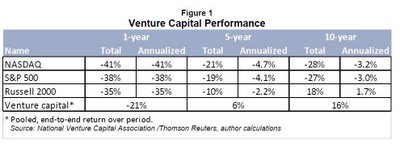
He moves on to analyze venture capital performance, noting that historical annual returns were about 20% and arguing that the ten-year numbers are about to go negative because the bubble exits of 1999 will soon be excluded:

Having argued convincingly that venture capital has a performance problem, he then offers up three possible explanations. Perhaps, Kedrosky says:
- Too much capital is allocated to VC, driving higher valuations and lower exit multiples
- Shrinking exit markets (e.g., the decline in IPOs) are damping returns
- VC itself is suffering from structural flaws, for example, a habitual over-reliance on the relatively mature IT and telecommunications markets
Excerpt related to the last point:
The computer and enterprise software and networking markets are long past the peak of innovation in terms of being places for profitably investing significant early-stage money. At the same time, most IT entrepreneurs say today that it costs a fraction of what it did a decade ago to start a company [due to open source software, Internet distribution, and cheap hardware and bandwidth].
On reduced start-up cost, I largely agree. On being long past the peak of innovation, I disagree. I believe that technology innovation is largely stalled in IT with business model disruption (e.g., open source, SaaS, cloud) in vogue and dominating new investments. I doubt that a new, technology-disruptive enterprise software company that is not SaaS or open source could even get first-round funding today. I think this means real opportunity in mid-term for technology disruptors and (happily) fewer competitors for Mark Logic while so doing. Yeah!
Kedrosky continues, making some interesting statements on IPO window closure:
There is no question that the number of venture-backed IPOs has declined [to a little more than half] the pre-bubble number … but it did not decline to levels completely out of line with [the pre-bubble] period … what has changed is that the market has become less accepting of young, money-losing companies than it briefly was in the late 1990s …
It is a mistake to say that the problem is the exit market — it would be more correct to say there is a problem with what VCs once were able to bring to market, but no longer can.
At this point, I’m thinking this guy is one heck of a conventional wisdom challenger and a fine analyst, but again I have to disagree:
- If the IPO window were open, there were no SOX tax, early-stage public company valuations were weak, and thus VCs would not take companies public that they heretofore would, then I’d agree
- But there is a SOX tax that makes marginally profitable companies unprofitable and the IPO window is basically closed so we don’t know if the market valuations are good or bad because there is no public market for the stock of these companies.
As I’ve often mentioned, $30M high-growth, break-even companies could go public and get reasonable valuations in the pre-bubble era (e.g., Business Objects in 1994). Today, I know of $100M+, growth companies that can’t go public due to some combination of IPO window closure and SOX compliance and process / timing costs.
Kedrosky then proceeds to some interesting ROI arguments on VC as a category. This chart, for example, shows how the flood of capital into VC in the 2000 era has resulted in depressed returns thereafter.

Kedrosky then does a little “right-sizing” math, showing two different ways why he believes that VC should be about half the size it is today.
I should note that the Kedrosky’s conclusions are very similar those reached by Fred Wilson, author of the A VC blog, in his post The Venture Capital Math Problem which looks at the same issue but in a more bottom-up, back-of-the-envelope way. Wilson, with some quick math of his own, calculates that the exit rate can’t generate enough returns on the current investment rate of about $25B/year.
Excerpt:
So here’s the venture capital math problem. We need $150bn per year in exits and we are getting about $100bn. That $100bn produces roughly $50bn in proceeds for venture firms per year. After fees and carry, that $50bn is around $40bn. Which is only 1.6x on the investor’s capital if $25bn per year is going into venture funds. If you assume the investors capital is tied up for an average of 5 years (venture funds call capital over a five year period and distribute it back over a five year period, on average), then the annual return is around 10%.
If you’re really interested in this topic go read the 250+ comments on Wilson’s post (and his follow-up).
One of my favorite comments was this one:
Put all of this together and the conclusion is crystal clear. The VC class does not scale for one simple reason: dearth of good VCs.
To be successful in this class you need to have capabilities that far exceed the “random selection” approach, and very few have them. The source of pitches is practically unlimited, even if you are good at sieving out 90%, you are still drowned out in low-quality pitches. You need to be able to dismiss 99.9% or better of the low-quality pitches. Only few can do that, and they have limited bandwidth, that’s why the class does not scale.