Re-Inventing Business Intelligence

Here’s a thought-provoking piece from Curt Monash, writing for Intelligent Enterprise, entitled Re-Inventing Business Intelligence.

The basic argument is that BI is due for a revolution. I agree. In the nearly 5 years since I left Business Objects, the innovations that I see from “the other side” are few and far between. In fact, I’d argue the whole software industry is so tied up managing the aftermath of consolidation that it’s basically forgotten about innovation.

Consolidation might be good for market share, profitability, and maybe — if I’m in a good mood — integration, but innovation has suffered. This, by the way, helps explain why I’m at an early-stage private company. Not only do I personally prefer innovation, but I think there’s a large innovation gap in the top mega-vendor offerings, which leaves plenty of room for technology disruptors like us.

I particularly liked the linkage Curt made to Google Wave. Now, by the way, I think if Google could have shortened the one-hour twenty-minute “overview” video to say, 15 minutes, we’d have seen a bigger uptick in GDP this quarter because almost everyone I know has somehow found 80 minutes to watch the thing. And, while cool, I think it’s easily explained in 15 minutes. (Think of the productivity losses! And that’s not including all the time wasted telling “if you feel like applauding at any time, just go ahead” jokes.)

By the way, if you feel like applauding at any time while reading this blog, just go ahead.

In any case, I think Curt makes an excellent point: if you want to see something innovative, go look at Google Wave. Then ask yourself when was the last time that any BI vendor proposed something as disruptive/innovative as that?

The answer, in my maximum curmudgeonly opinion, is around 1990, when Business Objects introduced the semantic layer. Everything after that, including the decade it took to get reasonable web re-implementations, has been incremental. Most everything else has been acquisition (e.g., EPM, text mining, ETL) and integration.

My Favorite Wolfram Alpha Query

There’s been so much hype about the would-be, Google-killer, computational knowledge engine Wolfram Alpha, that I’ve been reluctant to blog about it both because I’m not eager to contribute to the hype tsunami but also because I’m so overwhelmed by the number of articles I’ve bookmarked that it would take hours to sort them out into a coherent post.

To give you an idea of how much Stephen Wolfram thinks his work, the “quick introduction” video is 13 minutes and 23 seconds.

In short, I think Wolfram Alpha is “Powerset meets semantic web.” What do I mean by that?

  • Powerset was all about natural language for query formulation and the non-elimination of stopwords. They accused search engines of making you grunt in “pidgin English,” eventually leading to the creation of grunting pidgeons t-shirts.
  • Semantic web is, in my opinion, all about the web as queryable database.

Wolfram Alpha is about putting those two ideas together. Wolfram Alpha will use the contents of the web to get you an answer — as opposed to a link that might contain an answer — to your question. (It is like MarkLogic in returning answers, not links.)

But with all the hype and pre-positioning, I think this thing is way more likely to be the next Cuil (total crater) or the next Powerset (expedient early $100M exit to Microsoft) than the next Google. Ironically, Google itself didn’t come with massive pre-hype. They just built up a great business.

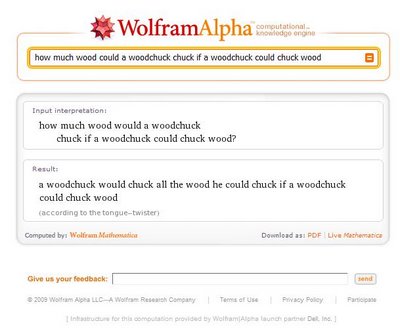
So, rather than take a deep, heavy approach to Wolfram Alpha, I thought up a fun example instead. I asked Wolfram Alpha: how much wood could a woodchuck chuck if a woodchuck could chuck wood?

Here’s what Wolfram Alpha said, which wasn’t bad:

More information:

OpenTable Has Been Chosen: A Successful IPO

One of my favorite kids’ movie scenes has always been the inside the claw game sequence in Toy Story. The heroes (Buzz and Woody) are trapped inside one of those games where you drop a claw and try to win a novelty gift, in this case a mutant alien doll.

Buzz: Who’s in charge here?
Dolls (looking up): The claw!!
Another Doll: The claw is our master!
Another Doll: The claw chooses who will go and who will stay!

Doll (grasped by the claw): I have been chosen! Farewell my friends!!

I love the accidental assignment of reverence to a game of chance. I love the perspective it provides on the “why me” situations we all inevitably face. And I love it as a metaphor for business situations.

For example, wearing my MBA hat, I’d say that if you want to get picked by the claw:

  • You need to be inside the machine, not anywhere else (e.g., on the loading dock)
  • You need to be at a good place inside the machine (e.g., after analyzing a pattern of where the claw drops more or less frequently)
  • And the rest is up to some combination of chance and external forces

Applying this to start-up companies, if you want to do an IPO:

  • You need to be a growing private company
  • You need to get yourself into the IPO window by hitting a set of size, growth, and profitability parameters
  • And you need the claw to pick you

This week, the claw chose OpenTable, the online restaurant reservations service founded in 1998, which today includes 10,000 restaurants and seats an average of 2.8M diners per month. Let’s take a quick look at their numbers:

  • 2007 revenue: $41.1M (+51% over 2006)
  • FTQ07 revenue: $29.4M (FTQ = first three quarters)
  • FTQ08 revenue: $41.3M (+40% over FTQ07)
  • 2007 operating income: -$0.9M
  • FTQ07 net income: -$0.7M
  • FTQ08 net income: $0.3M

So we see revenue growth of about 40-50%, profitability of about breakeven, and size of about $50M. (If you apply the FTQ08 growth rate to 2007 revenue, you end up figuring around $57M in 2008 revenue.)

All in all, I’d say this is pretty well in line with my estimated IPO window of 50/50/0 — i.e., $50M in revenues, 50% growth rate, and 0% operating margin.

As of 12/31/08, they employed 297 people.

Prior to the offering, which raised $60M for the company, its capital structure included:

  • Benchmark Capital: 26.4%
  • Impact Venture Partners: 17.5%
  • IAC/InterActive Corp: 10.9%
  • Integral Capital Partners: 7.5%

So, in aggregate, it appears that investors own 62.3% of the company for which they paid, in aggregate across three rounds, somewhere between $54M (as per Tradevibes) and $84M which is the total of preferred stock plus additional paid-in capital which presumably includes exercises of common. I don’t have time to reconcile the difference right now, but let’s call it $60M so we can continue the math fun.

Now, somewhat surprisingly, the stock had a big run-up after it came public. Per this TechCrunch story, the stock rose almost 60% on the first day, giving the company a market capitalization of $600M. That means the investors’ aggregate return is about 6:1 ($60M to buy a portion currently worth $360M — i.e., 60% of $600M). Remember that all these numbers are very rough and I’m reasonably sure the price varied greatly between rounds. But, overall, a healthy 6:1 for the VCs isn’t bad.

The San Jose Mercury News dramatized things a bit with this story: OpenTable IPO Ends Drought, Brings Hope to Valley. Excerpt:

But the recent paucity of IPOs has caused alarm for the venture industry,and has intensified a continuing shakeout among valley VC firms.The benefits of a healthier IPO market should ripple through the tech economy. Investors will use returns from successful IPOs to provide financing for seed-stage and mid-stage companies. Other investors will flock to invest in the valley once they see big payoffs as tech firms go public.

University of San Francisco business Professor Mark Cannice said the activity could “allow the Silicon Valley entrepreneurial machine to shift into a higher gear in 2009 and 2010.”

Overall, I’d say it is good news for the valley and, I’d argue, the individual investor (see past rants), if the IPO window does indeed open again.

For more information:
Precision, Confidence, and When The Dead Peaked

The other day I found this New York Times story, Bring Out Your Dead, about The Dead’s “resurrection” tour this Spring, and it both cracked me up and got me thinking.

Excerpt:

I asked [a guy I’d met] when he thought the Dead reached its peak, game to try out a half-formed argument for 1975 or thereabouts.

“Well, I agree with the people who say it was May 8, 1977,” he said.

Take a minute to think of the different levels at which one could answer the question, when did The Grateful Dead peak?

  • By album (e.g., Workingman’s Dead)
  • By decade (e.g., the 1980s)
  • By song (e.g., Touch of Grey)
  • By era (e.g., the Pigpen era)
  • By keyboardist (e.g., the TC period)
  • By year (e.g., 1987)
  • By date (e.g., May 8, 1977)

Clearly the specificity with which you answer a question is some implicit sign of knowledge. Ask a layman the height of Mount Everest and you might get “about six miles.” Ask a mountaineer and you’ll get “29,029 feet.”

Sometimes other factors drive specificity. Ask my friend Jon Temple how long he worked at Business Objects and he’ll say “36 quarters.” I say “9 years.” The difference? Jon was in sales and I was in marketing. So specificity can also reflect mentality. (By the way, it’s my 20th quarter at Mark Logic.)

But I loved the Deadhead’s answer because it wasn’t just a precise date — which itself would have been astounding given the band’s 30 years of touring — it was a whole level beyond that:

  • Awareness of the existence of
  • A group of people who believe it was May 8, 1977
  • And concurrence with their opinion

Wow.

The article goes on to discuss the Grateful Dead’s taping culture and its consequences, which I’ve long believed provides a forgotten roadmap for media companies in dealing with digitization.

End of the IPO Drought in Sight?

See this post by venture capitalist Fred Wilson, guest bloggging on Business Insider (nee Silicon Alley Insider) and re-posted on his own well regarded A VC blog, entitled The End of the IPO Drought is Coming.

The five key points of the argument are:

  • VCs have been in the penalty box for the dot-com era for nearly 10 years. It may well be time to let them out.
  • There are a lot of solid companies in the IPO pipeline
  • Many of those solid companies have annuity business models
  • When investors want to buy small company stocks again they are going to want to buy simple, one-product businesses they understand that drive growth and aren’t too fancy (i.e., no financial tricks). That’s what VC creates.
  • Sarbanes-Oxley is now well sufficiently well understood so that compliance costs are dropping.

I agree with the first 4 points. On the last one, I’m not yet convinced. Certainly, experience has made things better, but my friends who run small public companies still describe SOX as a 2-4% tax on revenues, which is doubly difficult because these companies often have single-digit margins to begin with, and ergo end up unprofitable after SOX costs.

In addition, he discusses the NVCA (not to be confused with the NCVA at whose events I recently spend too much time) and its proposed four-point plan to restore liquidity to venture capital.