Kellblog covers topics related to starting, leading, and scaling enterprise software startups including company strategy, financing strategy, go-to-market strategy, sales, marketing, positioning, messaging, and metrics
Bernard Liautaud, co-founder of Business Objects, and CEO for the company’s initial 1.5 decades, las landed as a general partner at Balderton Capital in London. See the press release from Balderton, suitably in English here or French here.
Balderton was an investor in MySQL, acquired by Sun in January, and on whose board Liautaud sat. They are also an investor in Instranet, a provider of multi-channel knowledge applications, founded by former Business Objects engineering head, Alexandre Dayon, and former French operations chief Jean-Noel Grandval.
One of the items I’m tracking in this blog is Convera’s burn-the-ships attempt at transition from a Federally focused enterprise search provider to a vertical search platform provider.
Yesterday, Convera announced their first-quarter fiscal 2009 (1Q09) financials, so let’s check in and see how things are going:
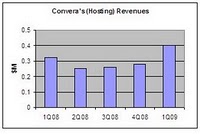
Revenues of $0.40M
Year-over-year growth of 24% compared to 1Q08 revenues of $0.32M
Consecutive growth of 44% compared to 4Q08 revenues of $0.28M
Ending cash and equivalents of $31.4M
Cash burn of $5.3M
COGS of $1.8M on running the hosted services, suggesting gross margins of -348%
6 new Excalibur-supported vertical sites (for a total of 45)
1 new publisher launching an Excalibur-supported site (for a total of 25)
My analysis:
The revenue numbers are still tiny in an absolute sense; usually the law of small numbers would apply, meaning that off such tiny figures we’d see multi-hundred percent growth rates. At 24% compound year-over-year growth, it takes Convera 5 years before they’re doing million-dollar quarters. Yikes.
The 44% consecutive growth rate out-pacing the 24% year-over-year growth rate is usually a good sign as it implies acceleration. However, due to the seasonality of software revenues, I believe that year-over-year growth is the more reliable (and easily interpreted) growth metric. Ergo, I put more faith in the 24% than the 44% as the indicator of real growth.
That said, an up-quarter from 4Q to 1Q is usually a good sign since software (and to a lesser extent SaaS) companies tend to have back-loaded, seasonal sales that result in a saw-tooth revenue curve where 1QN+1 revenues are often a bit less than 4QN, even when the company is experiencing strong growth.
That said, Convera’s 4Q08 was worse than their 1Q08, providing an easy comparison point for the 1Q09 numbers. Simply put: does 44% 1Q09 consecutive growth mean “great 1Q09,” “bad 4Q08,” or a bit of both? (Sometimes, the easiest way to interpret all these relative growth rates is just to make a chart, which I eventually did, and included above.)
The cash burn rate is sustainable over the mid-term, but not the long-term. They have $31M in cash ($35M including $4M held in escrow) and they are burning $5M/quarter. At that rate, the cash lasts 7 quarters.
Overall customer acquisition to-date seems good, and 25 publishers signed-up is fairly impressive. But, in my opinion, publishers are drawn — like moths to a flame — to the something-for-nothing idea that they can invest little and get a vertical search site. The question is will Convera ever be able to charge enough to run a profitable business? Right now, Convera is subsidizing their customers’ sites to the tune of more than $20M/year. Going forward, they’ll either deliver enough value to extract enough revenue to run a profitable business, or their customers will scatter like cockroaches when they try. Time will tell.
The new customer acquisition/deployment figure of 1 suggests deceleration and is, in my opinion, not good.
The company says 75 vertical sites are under contract (compared to 45 launched) with 25 publishers. This sounds good and tends to indicate broad acceptance of the strategy.
But the earnings call transcript reveals that a single customer accounted for 80% of revenue during 1Q09 and this same customer was 82% of revenue in 4Q08. I sure hope Convera keeps this customer happy, since they’re doing only $100K/quarter in revenues without them. This undercuts the credibility of the claims that support broad success.
In the transcript, CEO Pat Condo gives revenue growth guidance for 2Q09 of “over 25%.” It’s not clear if means consecutive or year-over-year growth.
There’s a lot of happy talk about traffic both in the press release and in the earnings call transcript. I’ve disregarded it for two reasons: (1) it’s a busy week and I’ve not had time to fully parse it, and (2) the kind of traffic in which I’m most interested turns to revenue and should show up in the financial statements.
In the transcript, they say that total 1Q09 expenses net of non-cash charges for depreciation and stock-based compensation were $3.6M. They guide that the same expense metric will run between $2.8M and $3.4M per quarter in the coming year. This, and other comments, suggests they have done some heavy cost-cutting, and thus that the cash will last even longer than my previous calculation suggests.
Overall, I’d say the experiment is still in progress. Convera has plenty of cash to keep it running, so let’s see what happens. Personally I’ll be watching customer acquisition and deployment, revenues, revenue concentration, and cash.
(And, by the way, Convera, you can revise government out of your safe harbor statement; you sold that business to Fast some time ago.)
Ultimately, I’m cynical on the notion of cheap-as-chips vertical search. I believe the answer for publishers is not to focus on lowering costs, but instead to focus on creating value. For more on that riff, read (the end of) this post (Blind Eyes, Industry Analysts and Lessons from B2B) or see my slides from the recent E-Publishing Innovation Form in London, embedded below.
Here are a few quotes from the Microsoft press release:
Microsoft hosted in Cambridge today a number of independent software vendors (ISVs), including Novell Inc., Mark Logic Corp., … to launch this collaborative, community-based initiative. The Cambridge event is the first in a series of labs around the world that will bring together vendors to test interoperability between their implementations of well-known document formats […] will test interoperability between existing implementations of Office Open XML Formats and the Open Document Format (ODF) …
[…] said Jean Paoli, general manager for Interoperability and XML Architecture at Microsoft. “The labs are designed to bring technical staff together to roll up their sleeves and test interoperability between implementations of formats and address issues that are identified either in those implementations or in the translation technologies used to work across formats.”
[…] said Andy Feit, senior vice president of Marketing at Mark Logic. “Enhancing document format interoperability between MarkLogic Server and other products in the marketplace will make it much easier for our customers to deploy applications for content assembly, reuse and delivery.”
Kelly appears near the end, so you’ll need to hang in there a bit to see him. The video is in total about 4 minutes long. Check it out!
Competition. While MarkLogic is not a search engine we did end up competing with Fast at several major media (i.e. publishing) accounts, so they had my attention.
Seen this before. Fast reminded me of MicroStrategy, against whom we successfully competed at Business Objects, but whose tactics caused me more than a bit of angst over the years. (One might argue this comparison was prescient.)
Speaking out. I felt that despite the presence of evidence (e.g., financial analyst reports from a Scandinavian bank that did some pretty convincing analysis) that things were awry that everyone (i.e., industry analysts, customers) seemed to turn a willing blind eye first to the indicators of the problems and then to the problems themselves — either dismissing them entirely or as characterizing them as simple “accounting issues.”
Knew the right way. Also, from my near-decade’s worth of experience at Business Objects, I had a strong sense for what I felt was the “right way” to run a European software company. Basically, play by the same rules as everyone else — dual list on the NASDAQ and report financials under GAAP.
Anyway, with the Microsoft acquisition, I figured the story was done. While I was always amazed at the valuation — particularly for a company in the midst of an accounting scandal — the problems were well publicized and I figured Microsoft had to have looked into every angle.
A recent story in Portfolio, entitled Fast Troubles for Microsoft, suggests this was perhaps not the case. Excerpt:
Even as it agreed in January to plunk down $1.23 billion to buy a promising but problematic search company in Norway, Microsoft knew that the company had some accounting matters to address.
Now, it appears, the acquired company, Fast Search & Transfer, may have some criminal matters to work out: Suspicions about the Norwegian search-engine company’s revenue reporting are now in the hands of the Oslo police.
Norway’s financial supervisory authority, Kredittilsynet, said its review of Fast Search’s previously disclosed accounting problems not only appeared to have violated accounting standards, they may have broken the law too.
[…]
In its haste to grab Fast Search, however, Microsoft looked past the company’s problems: They include, but aren’t limited to, accounting irregularities that began to appear as Microsoft began to look over its books.
In the second quarter of 2007, Fast Search reported an operating loss of $38 million on revenue of only $35 million—a full $20 million below forecasts. The loss widened in the following quarter, leading the Norwegian stock exchange to delist Fast Search on December 12.
That same day, Fast Search said it would review its accounting for all of 2006 and 2007. The latest unaudited results show revenue growth of 7 percent for last year, which is far below Goldman’s forecast.
Kredittilsynet, the supervisory agency, was equally determined. It referred Fast Search to investigators at Økokrim, the Norwegian National Authority for Investigation and Prosecution of Economic and Environmental Crime.
Økokrim last week concurred that the nature of the irregularities and the amount by which Fast Search apparently inflated its accounts were serious matters warranting prosecution. But the agency said it was too busy to open a criminal investigation.
Rather than let the matter rest, the market supervisor turned it over to the Oslo police for investigation. Aftenposten, a Norwegian newspaper, characterized Kredittilsynet’s decision to involve the police as an unprecedented step in that country.
Go here to check out coverage of the recent panel session I did in New York City at the CMO Club summit. Overall, I enjoyed participating on the panel and want to thank both Pete from the CMO Club for inviting me and the other panelists for the fun debate.
(From left to right, me; Jarvis Cromwell, CMO of StormExchange; and Barry Herstein CMO of PayPal.)
The panel was about career management for CMOs and I was there to provide the “from CMO to CEO” angle. Not surprisingly with a bunch of marketing people, I had trouble getting a word in edgewise. :-)
Here are some of the points that I made which are covered in the blog post:
Marketing is struggling for relevance. Product and sales groups are very powerful. Marketing gets relegated to a communications role.
Present yourself as a business person, not a marketing person. Be with a successful company. People will ask you why you stayed so long with a losing company.
Your job is to make sales easier. Don’t be in the way. Surprisingly it’s very hard to get that alignment.
Overall, I’d make a few additional points of advice to my fellow marketers (while I’ve been a CEO for 4 years I nevertheless still consider myself a marketing guy and probably always will):
Talk less, listen more. We marketers are a chatty bunch and need to be self-aware.
Align to the business. Make this a never-ending quest. See point 1 for help in doing it.
Remember that for the sales VP and the CEO, it really is all about the numbers. It’s easy to preach about long-term investments, brand-values, and other lofty things. Do so once in a while as it’s your role, but do so with care. Choose your battles.
Market for your sales force, not for other marketers. Marketing is a self-congratulatory discipline. Lots of campaigns that win awards don’t move the sales needle an inch.
I have one story from the panel that I think contains a rather pointed lesson. It goes like this:
Audience member: I have a question — how many people in this room, panelists included, have ever carried a bag in sales (i.e., had a sales job and sales quota)?
About 10% of the hands go up. Mine is not one of them. But I think the woman’s begging a great question: can you, and how can you — if you’ve never walked a mile in their shoes — support sales? It’s a great topic. I’m ready to riff on it. (My favorite riff is about the poor salesperson who joins marketing or sales operations thinking sales will continue to see him/her as “us” when unbeknownst to them, in the eyes of their former quota-carrying colleagues, they transition from “us” to “them” approximately 10 nanoseconds after renouncing their quota.)
I’m ready to go, thinking this is going to be great.
Moderator: OK, now let’s talk about “the brand called me” in managing your career.
Me: Wait a minute. You, in the audience, where were you headed with that sales question?
Audience member: I was thinking about how we can support sales if we’ve never done sales, and that maybe people would be interested in discussing that?
[Sound of crickets chirping]
Moderator: OK, now let’s talk about “the brand call me”
Don’t get me wrong. I’m a big believer in the whole “brand called me” thing and agree that people should treat themselves as marketable products (from a resume perspective) and establish clear positioning and differentiation. That’s all great.
But isn’t there something wrong when a bunch of marketing people would rather talk about the “brand called me” than sales? Isn’t that part of the problem?
My closing comments on the panel were as follows:
For career success as a marketer first realize that as CMO you inherently have a dual role: head marketer and e-staff contributor.
Build a very strong team that you can basically leave alone to run marketing
Then put your effort into the e-staff contributor role to help you both develop as a business person and contribute to your company’s success.
And finally, I want to know why only me and the woman dressed in black want to talk about sales. (She’s my bet for the next CEO in the crowd.)
I’m Dave Kellogg, advisor, director, blogger, and podcaster. I am an EIR at Balderton Capital and principal of my own eponymous consulting business.
I bring an uncommon perspective to enterprise software, having more than ten years’ experience in each of the CEO, CMO, and independent director roles in companies from zero to over $1B in revenues.
From 2012 to 2018, I was CEO of Host Analytics, where we quintupled ARR while halving customer acquisition costs, ultimately selling the company in a private equity transaction.
Previously, I was SVP/GM of the $500M Service Cloud business at Salesforce; CEO of MarkLogic, which we grew from zero to $80M over six years; and CMO at Business Objects for nearly a decade as we grew from $30M to over $1B in revenues.
I love disruptive startups and and have had the pleasure of working in varied capacities with companies including Bluecore, FloQast, Gainsight, Hex, Logikcull, MongoDB, Pigment, Recorded Future, Tableau, and Unaric.
I currently serve on the boards of Cyber Guru, Light, Scoro, TechWolf, and Vic.ai. I have previously served on boards including Alation, Aster Data, Granular, Nuxeo, Profisee, and SMA Technologies.