How Much Does My General Manager Need to Know About My Department?

Question from a reader:

Dear Dave,

How much does my general manager need to know about my department?  Frankly, he/she doesn’t seem that interested in what we’re doing or spend that much time with us — which I suppose is a good sign in some ways.  On one hand, I’d love to deep dive into all the great things we are doing.  On the other, I don’t want to bore him/her with a lot of unnecessary detail and be seen simply as yet-another engineering manager who doesn’t “get” the business.

The first answer to this question reminds of an 800-pound gorilla joke.  Q:  Where does an 800-pound gorilla sit?  A:  Wherever it wants to.

That is, your GM needs to know whatever he/she wants to know about your department.  So I’d listen closely about what he/she requests in terms of information and make sure you deliver that.  Don’t make the all-too-common mistake of not providing what is asked for, but offering lots of other information instead.  That’s like serving more icing than cake and, personally, I see it as either incompetence or a deliberate diversion.

Because (I happen to know that) your GM is not a functional expert in your department, he/she may not have a clear sense of what information is of interest.  So he/she may place the burden on you of figuring out what information is appropriate, say, for a 30-60 minute quarterly ops review presentation, or a 1-1 meeting.

In that situation, we can use some first principles to guestimate what the GM wants to see.  All good GMs care about:

  • Sales, which is typically measured by ACV in a SaaS company.  Remember, this is the raison d’etre for the GM role — i.e., the reason the company has a unit GM is precisely because they want someone focused on and accountable for the unit’s sales.  Because sales is a trailing indicator, GMs are usually focused upstream on pipeline as a leading indicator of sales.
  • Customer satisfaction as measured directly through surveys, anecdotally through escalations, and indirectly through renewals.
  • The team.  Who are the top performers and how are we retaining them?  Who are the bottom performers and how we are improving their performance?  Who is in the middle and how we are developing them?
  • Objectives and accountability for achieving them.  What objectives are you working towards, why were they chosen over alternatives, how do they tie to the unit and company goals, and how are you doing on achieving them?  Personally, I am a stickler presenting prior-period objectives in a verbatim form, because too many people try to hide the very normal tendency to miss some of them.  Far better, in my opinion, to reach a bit in setting objectives and miss a few than game the system so that you are always hitting 100%.
  • Key departmental metrics.  I think every manager should have 5-7 topline metrics that they use consistently to measure the department over time.  Because they will be used over time as the company scales, it is often best to normalize these.  Cases/agent or cases/customer is more interesting over time than just the number of cases.  Bugs/customer or bugs/engineer is more interesting than total bugs outstanding.

So let’s try to apply the above to answering your question.

  1. I’d sit down with the GM and determine what your topline metrics should be — this is often a long and interesting series of conversations.  This exercise is, in my experience, never as simple as it might appear.
  2. I’d sit down with the GM and ensure you are aligned on quarterly objectives.  In a matrixed organization where you are reporting to both a product line GM and a functional vice president, this can be harder than meets the eye.
  3. I’d think hard about how what your department does ties to sales.   While your functional boss will focus on about  best practices, your GM will — as noted — invariably focus on sales.  For development that might be about neutralizing competitive features.  For QA/QE, that might be producing a higher-quality product on faster cycles than the competition.  For UE, that might be studies reflect not only on how designs work with existing customers, but particularly on how prospective customers react on an first-impression basis.  For techdocs, that might be how can the documentation make the product sufficiently better so as to influence sales, perhaps by highlighting competitive strengths in examples and tutorials.
  4. I’d think hard about how your department ties to customer satisfaction and renewals, using the same approach as above.
  5. I’d provide a quarterly update on the team citing top/bottom performers, key hires and informally discussing team issues within the quarter.
  6. Finally, I’d make a point to make myself “more than a department head” by spending as much time as possible learning the product / market / competition and talking live with customers, e.g., during corporate visits, user conferences / groups, et cetera.  This will facilitate all the prior points and help  you get ready for your next promotion!
A Few of My Favorite Quotes

For a change of pace, I thought I’d do a quick post with some of my favorite quotes.

  • “In preparing for battle, I have always found that plans are useless but planning is indispensable.” — Dwight Eisenhower
  • “Management is doing things right; leadership is doing the right things.” — Peter Drucker
  • “The single best question for testing an organization’s character is:  what happens when people make mistakes?” — Bob Sutton
  • “The only place success comes before work is the dictionary.” — Vince Lombardi
  • “Maybe I’m a complete idiot, but I have no idea what anyone is talking about.  This [cloud computing thing] is complete gibberish.”  — Larry Ellison
  • “Common sense is not so common.” — Voltaire
  • “It ain’t what you don’t know that gets you into trouble; it’s what you know for sure that just ain’t so.” — Mark Twain
  • “We always overestimate the change that will occur in the next two years and underestimate the change that will occur in the next ten.”  — Bill Gates
  • “Be careful what you pretend to be because you are what you pretend to be.” — Kurt Vonnegut
  • “All companies go out of business for the same reason.  They run out of money.” — Don Valentine
  • “Man sacrifices his health in order to make money. Then he sacrifices money to recuperate his health. Then he is so anxious about the future that he doesn’t enjoy the present:  the result being that he does not live in the present or the future; he lives as if he is never going to die, and then dies having never really lived.”  — The Dalai Lama
  • “They never missed an opportunity to miss an opportunity.” — Abba Eban
  • “If I had asked my customers what they wanted, they would have said a faster horse.”  — Henry Ford
  • “Opportunity is missed by most people because it is dressed in overalls and looks like work.” — Thomas Edison
  • “The nine scariest words in the English language are:  we’re here from corporate and we’re here to help.”  — Adapted from Ronald Reagan

Note:  if you enjoy tracing quote attributions (and their correctness), then check out this site where I found the rather unlikely dual attribution to Yogi Berra and Niels Bohr.

Management and Bill Walsh’s Three Types of Players

A friend of mine who played football at Stanford, back when Bill Walsh was coach, told me a great story the other day.  He said that, according to Walsh, there were three types of players.

  • Those who need a kick in the butt.
  • Those who need a hug.
  • Those who need to be left alone.

As soon as I heard it, I thought two things:  he’s right in sports and it applies equally to management.

One of the reasons I don’t believe in hard-and-fast rules that supposedly make things “very equal” among people is that people are very different.  Some folks are motivated by money, some aren’t.  Some need praise and reassurance to do their best work.  Some know exactly what they want to do and exactly how to do it.

Good bosses, in my opinion, do not create organizations where everyone is treated identically.  Instead, they adapt their management style to each of their team members.  In the end, your job is not about equality.  Your job is about getting the best work out of your team.

As I boss, I have two long-term metrics for my success:

  • Will the people who have worked for me later say that they did some of the best work of their lives under my leadership?
  • Did the people who worked for me go onto greater things in their career?  How many later became CEOs, CMOs, or GMs?

If you keep a focus on these two long-term goals, hire excellent people, and adapt your style to them, I think you can become an epic manager and leader.

So kick some of your team, hug others, and leave the rest alone.  Great things will happen.

What To Do If You're Winning the Product Evaluation But Losing the Deal

Dear Dave:
I think the art of negotiation is dead. Over the past two years we have won over prospects on our product capabilities, but then lost out on price to inferior products. In all recent cases the prospect never once negotiated with us for a lower cost but clearly their staff preferred our product. I am baffled by the lack interest in negotiation among these generally price-sensitive buyers. It has become a guessing game of sorts for us to figure out what someone can afford. What do you think is going on?
Dear Reader:
I believe the customer is not negotiating because they are not interested in your offering, even at a lower price and despite the fact that the recommending team may strongly prefer your product. I agree that the buyers in your segment are price-sensitive so this may be counter-intuitive, but I also believe the buyers in your segment are quite conservative. So I think you are getting your legs cut out from underneath you “up the chain” at a business level on business issues like risk, “safe choice,” and company size.
While my take is pure speculation it would certainly explain how you can win the product evaluation with the buying team and then lose the deal without even having a price negotiation. So the problem isn’t a lack of interest in negotiation, it’s that your deal is getting killed up the chain, probably by a sales manager or regional VP from a mega-vendor who is hitting both the business buyer and probably the CIO with “safe choice” message. (As in, you aren’t one.)
Thus, I don’t think price experimentation is going to help your problem. In fact, and sorry if this irks you, I’d bet $100 that the customer is paying more – maybe 2-3x more – to buy from the mega-vendor. The customer is, in effect, paying a hefty risk premium on the “nobody ever got fired for buying IBM” logic chain.
So here’s what I recommend to improve your odds:

  • Ask your marketing person to call several recent losses, ask for a debrief, and try to validate this hypothesis. Most important words: “I am not trying to sell you anything, I am researching this issue so we can do better next time.”
  • Get you and your sales team working higher in the organization, and building relationships with the business buyer and the CIO/CTO. I can 100% guarantee you that mega-vendor has these relationships.
  • Once working at that level, inoculate the customer against the safe choice message. Remind them of mega-vendor’s 50% operating margins (“Gee, I guess none of the profit is coming from you; it must be their other customers.”) Document and remind them of the total cost of owning mega-vendor’s solution vs. yours over the lifetime of the project. Shares stories of peer organizations who have been successful with your solution. Offer peer-level, senior business references to validate your claims.

Remember what you are trying to do is de-value the risk premium that the mega-vendor is selling.

  • Mega-vendor’s argument: [1] we might cost 2-3x more, but we will eventually get the job done, and [2] even if we mess it up, remember that no one ever got fired for buying from us.
  • Your argument: [1] why pay 2-3x more for worthless insurance policy – our customers are successful and I can prove it, [2] and while no one ever got fired for buying from mega-vendor, nobody ever got promoted either.

We can deliver this project better/cheaper/faster and tee you up for additional success downstream. To paraphrase the classic old Harvard Business Review direct mailer: isn’t your career about more than not getting fired?
Good luck and let me know how it works out.

What Drives SaaS Company Valuation? Growth!

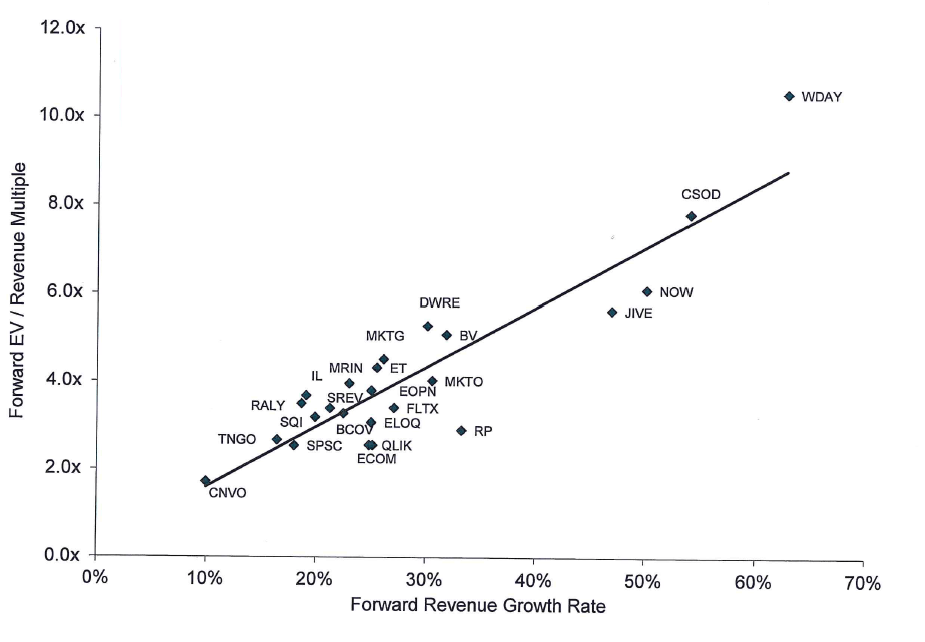
If you’ve ever wondered what drives the valuation of a SaaS vendor, then take a look at this chart that a banker showed me the other day.

saas valuations 2The answer, pretty clearly, is revenue growth.  The correlation is stunning.   Taking some points off the line:

  • 10% growth gets you an on-premises-like valuation of 2x (forward) revenues
  • 20% growth gets you 3x
  • 30% growth gets you 4x
  • 50% growth gets you nearly 6x

Basically (growth rate % / 10) + 1 = forward revenue multiple.

You might think that profitability played some role in the valuation equation, but if you did, you’re wrong.  Let’s demonstrate this by looking at CY13 EBITDA margins as reported by the same banker:

  • Marketo (MKTO) -44% with a ~4x revenue multiple
  • Marin Software (MRIN) -40% with a ~4x revenue multiple
  • Workday (WDAY) -22% with a ~11x revenue multiple
  • Bazaarvoice (BV) -6% with a ~5x revenue multiple
  • Cornerstone on Demand (CSOD) 0% with a ~8x revenue multiple
  • Qlik Technologies (QLIK) 13% with a ~3x revenue multiple
  • Tangoe (TNGO) 17% with a ~3x revenue multiple

As you can see, there’s basically no reward for profitability.  In real estate what matters is location, location, location.  In SaaS, it’s growth, growth, and growth.