If Marc Benioff Carried a Rabbit’s Foot, Would You?

In business we have a sad tendency to copy success blindly.

I remember the first time I read about this I didn’t even understand what I was reading:

“Nothing in business is so remarkable as the conflicting variety of success formulas offered by its numerous practitioners and professors.  And if, in the case of practitioners they’re not exactly “formulas,” they are explanations of “how we did it” implying with firm control over any fleeting tendencies toward modesty that “that’s how you ought to do it.”  Practitioners filled with pride and money turn themselves into prescriptive philosophers, filled mostly with hot air.”

Through blind luck, I’d had the good fortune that Theodore Levitt’s The Marketing Imagination (1983) was the very first book I read on marketing.  That paragraph — the opening paragraph of the book — stuck with me in some odd way, but it would be years before I truly appreciated what it said.

I was business-educated in the In Search of Excellence (1982) era and, while I suppose the same approach had been happening for years, In Search of Excellence was about as unscientific as they come.  The authors, Tom Peters and Bob Waterman, started out with a list of 62 companies identified by asking their McKinsey partners and friends “who’s doing cool work,” cut the list rather arbitrarily to 43 (excluding, for example, GE — but retaining Wang, Atari, and Xerox), and then “derived” eight themes which they thought were responsible for their success.

That was the mentality of the time.  Arbitrarily identify a set of companies you deem “cool” and then arbitrarily come up with things they have in common.  (And that’s not to mention the allegations of “faked data.”)

So I was happy when Jim Collins came along in 2001 arguing that he was bringing a more scientific approach in Good to Great.  Arguing that seeking only common traits could you lead to discoveries such as “all great companies have buildings,” Collins strove to differentiate good companies from great ones.  Starting with 1,435 companies and examining their performance over 40 years, Collins’ team identified 11 companies that became great along with 11 comparison companies in the same markets that did not.

While Collins’ thinking may have been clearer than Peters’, his luck was no better. Seven years after the book was published, several “great” companies like Circuit City were in deep trouble, Fannie Mae required a Federal bailout, and only only one of the eleven companies, Nucor, had dramatically outperformed the stock market.  Amazingly, despite the poor to lackluster performance of the “great” companies, it remains a best-seller to this day, ranking #5 on Amazon in management at last check.

Even when trying to avoid it, fake science and, in particular, survivor bias had struck again.  Thank goodness Phil Rosenzweig came along in 2009 with The Halo Effect, describing it and eight other business delusions from which managers suffer.  Here’s a nice excerpt:

On the way up to a stock market value of half a trillion dollars, everything about Cisco seemed perfect. It had a perfect CEO. It could close its books in a day and make perfect financial forecasts. It was an acquisition machine, ingesting companies and their technologies with great aplomb. It was the leader of the new economy, selling gear to new-world telecom companies that would use it to supplant old-world carriers and make their old-world suppliers irrelevant. Over the past year, every one of those characterizations has proved to be false.

As I often said about running analyst relations at Business Objects: “when the stock was going up everything I said was genius, when we missed a quarter, everything I said was suspect.”  This is, in my estimation, the real reason why some bad-egg companies such as bubble-era MicroStrategyFast Search & Transfer, or Autonomy (not yet settled) are tempted to inflate results.  I think it’s less about inflating valuation, and more about inflating the company’s perception of success in order to “validate” their strategy going forward.

But, to Levitt’s point at the start of this post, we are swimming in advice from successful practitioners.  

We have advice from Sequoia billionaire Mike Moritz who says the best advice he ever received was to “follow his instincts” which, as it turns out, works swimmingly well if you happen to have his instincts.  (And perhaps less so well, if you don’t.)

We have advice from billionaire Peter Thiel, who sounds vaguely like Timothy Leary with the drop-out part of turn on, tune in, drop out.

We have advice from Steve Blank, one of the more reasonable and thoughtful sources out there, and someone, in my opinion, to be admired for his commitment to giving back intellectually to Silicon Valley.

We have a plethora of advice from Marc Benioff, for example, the 111 “plays” in Beyond the Cloud, including “make your own metaphors” and “cultivate select journalists.” 

Who knows, maybe “beware of billionaires bearing business advice” may become the new “beware of Greeks bearing gifts.”

Finally, we also have advice from, dare I say, Kellblog who, while not a billionaire (yet), has opinions as tempered by experience and as firmly held as any of the above — and often as unscientific.

Given this sea of advice, how do I recommend processing it?  In the end, as Rosenzweig reminds us, in the absence of real silver bullets and magic formulae, we need to think for ourselves.  So every time I hear a successful businessperson bearing business advice I remind myself of one key fact — the plural of anecdote is not data — and ask myself two key questions:

  • Do I believe that he/she was successful because of, in spite of, or completely independent of this advice?
  • If Marc Benioff carried a rabbit’s foot, would I?

Strategic Focus: I’m Just Trying to Get My Space Together

As a long-time Grateful Dead fan, I have to say that I was advantaged in understanding how the Blown to Bits problem would affect digital media businesses.  You see, for years, the Dead had changed the business model of the music industry, choosing to use albums as a loss leader and to make money on live concerts, playing some 2,300 concerts together, not to mention those done individually by band members (e.g., Jerry Garcia at the Keystone Berkeley).

steal your face

The Dead even had a tapers section at most concerts and sometimes could be heard literally stopping the show to allow someone to reposition their microphones.  The Dead have a valid claim to “we did Freemium 30 years before Freemium was cool.”

While I won’t go as far to say that Everything I Learned about Business, I Learned from the Grateful Dead (a good book that takes top ten lessons from “the long, strange trip”), I do believe the Dead were both musical and business model innovators.

Improvisation as strategy was profiled in Competing On The Edge:  Strategy as Structured Chaos, published by Harvard Business School press.  Excerpt:

The Grateful Dead met this challenge through improvisation […] as distinguished by two key properties:  first, performers intensely communicate with each other in real time […] second, they rely on a few very specific rules, such as who plays first, what are the permitted chords, and who follows whom.

While I’m riffing on the Dead, I should probably also mention Marketing Lessons from the Grateful Dead, a great book on topics including community, branding, customer centricity, teamwork, category creation, technological innovation, disruptive business models, disintermediation, and giving back.  The Dead were innovators in all these areas and the book is well worth reading.

My favorite Dead-related quote, however, comes not from that book but from The Grateful Dead Movie, in a famous scene where a completely zonked head is ambling around outside the concert and tells a security guard the inimitable:

“I’m just trying to get my space together, so that I can go into the show.”

I always think of this guy whenever I talk to a startup about strategy.  Why?  Because startups are very much about trying to get your space together.

  • What space do you want to be in?
  • Against whom do you want to compete?
  • Where do you draw the boundaries on your space?
  • What adjacent spaces, if any, do you want to incorporate into your space?
  • In what adjacent spaces do you want to partner?
  • How do you see the boundaries on your space evolving over time?

My meta-answer to these questions is “the world is a very large place.”  How does that relate?  In two ways.  It means first that you better define your space in such a way that you are truly world-class within it — and not using world-class as a nice sounding compound adjective, but really grokking its meaning:  what can you truly be best in the world at doing?  Second, it means that because the world is a big place that you can turn what might appear to be a small niche into a  very big business if you are truly the best in the world.  So don’t be afraid to focus.

Most startups forget focus too early and delude themselves into thinking they can be world-class in across a number of areas.  Take enterprise performance management (EPM) — the space in which Host Analytics competes –for example.  EPM is a $4B market for financial analytic applications that is adjacent to the broader $13B business intelligence (BI) market.  Some of our competitors consider themselves addressing the (incorrectly calculated) “$33B BI market” and are either building or acquiring products in the broader BI space?  It sounds good from a total available market (TAM) perspective.  Wow!  You’ve tripled your TAM.

But think for a minute — what are the odds that  your cheaply-acquired or hastily built BI tools are world-class?  None.  So all you’ve really done is dilute your focus on EPM by complementing it with some third-tier BI.  A far better solution (and the one we follow at Host Analytics) is to partner with someone else who is spending all their energy focused on being world-class in the adjacent space.  In our case, that partner is Birst who is focused on being world-class at cloud BI.

So if you’re thinking of starting a company, ask yourself:  what can we really be world-class at doing?

Answering that question is the only way to get your space together, before you go into the show.

Burn Baby Burn: A Look at the Box S-1

I’m pretty busy this week so I was hoping not to dive into the Box S-1, but David Cummings’ excellent summary served only to whet, as opposed to satiate, my appetite.

Perhaps it was the $168M FY14 operating loss.  Maybe it was the $380M in financing raised during the last three years.  Or the average quarterly burn rate of $23M.  But somehow, I got sucked in.

I just had to know their CAC ratio.  Of course, it’s not going to be easy to calculate.  While they give us quarterly S&M expense, that’s only half the equation; we’re going to have a figure out –as best we can — quarterly new annual recurring revenue (ARR).

Billings as a Sales Metric

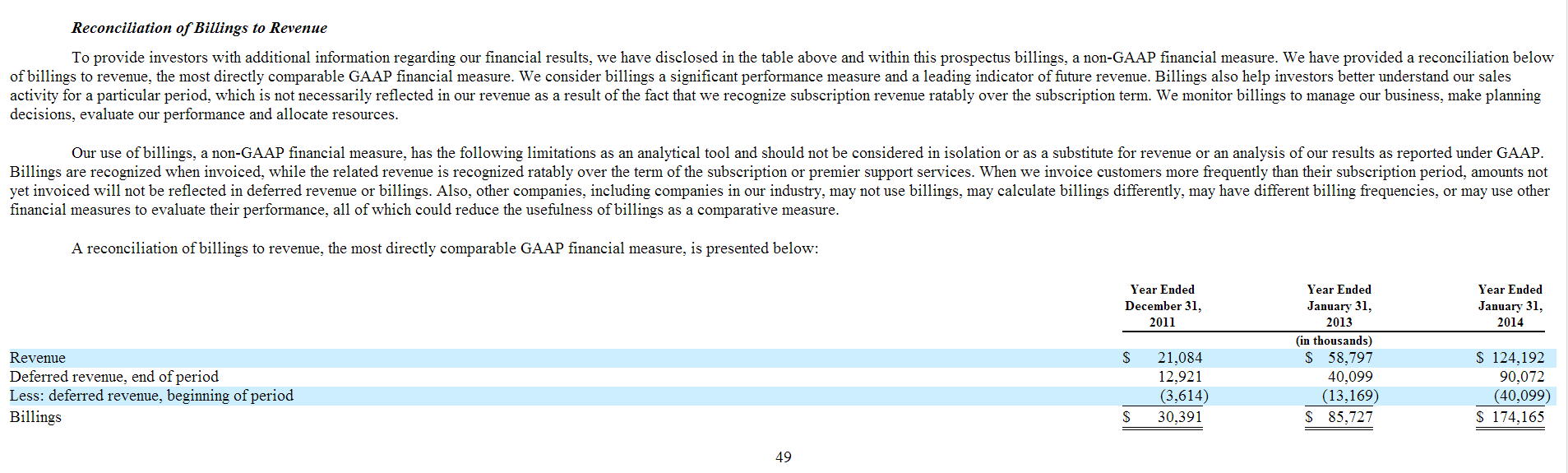
While many SaaS companies don’t disclose “billings,” Box does — but on an annual basis only — in their S-1.

[Click on the images to see full size.]

box billings

..

Billings is an attempt to triangulate on new sales (or bookings) in a SaaS company.  The standard way to calculate billings is to add revenue plus change in deferred revenue.

The idea is that if you want to know how “sales” went during a given period, then revenue is not a great indicator because, in a SaaS company, revenue is an indicator of how much you sold in prior periods, not the current one.  So you look at deferred revenue trying to pick up the volume of new orders.  The problem is that things quickly get very complicated because (1) deferred revenue is moving both down (as past deals convert into revenue) and up (as new deals are signed) and (2) deferred revenue itself is limited only to deals that are prepaid — if a company does a constant business volume but suddenly starts doing a lot of two-year prepaids, then deferred revenue will skyrocket and if, for example, hard economic times drive loyal customers to ask for bi-annual billing, then deferred revenue will plummet, all without any “real” change in underlying subscription business.  In addition, multi-year non-prepaid deals are invisible from a deferred revenue perspective (because there’s nothing, i.e., no cash prepayment, to defer).

In short, any metric built upon deferred revenue is only as a good as deferred revenue at reflecting the business.

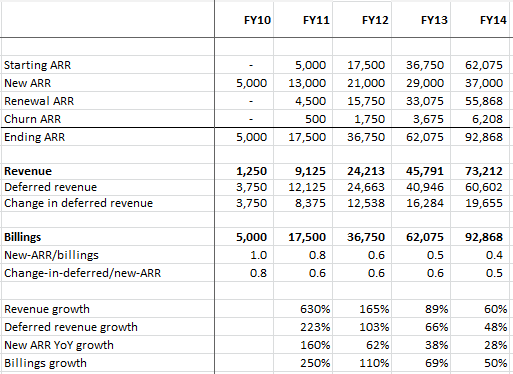
To demonstrate the relationship between billings and new ARR, I built a model which assumes a SaaS company that starts from scratch, increases new ARR added each quarter by $500K (i.e., $500K in its first quarter, $1M in its second, $1.5M in its third), does only one-year prepaid deals, and has a 90% renewal rate.  Here’s what happens.

(You can download the spreadsheet with Box financial summary and the full version of the model here.  Be sure to download as an Excel file, not a PDF.)

generic model

..

While in year one, billings is equivalent to new ARR, as you build up the renewals base, it contributes more to revenue and muddies thing up.  For a company of the above size, growth, and renewal rate, the ratio of new ARR to billings ends up 0.4.

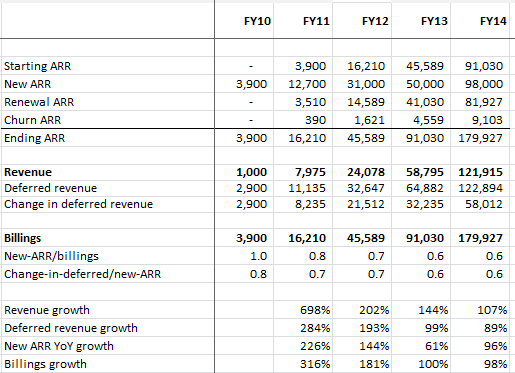
When you take this same model and (manually) force fit the new ARR numbers to try approximate Box’s revenue and billings from 2012-2014, you get:

box like model

..

A CAC of ~1.6

In this case (and given my assumption set) you end up with a new-ARR/billings ratio of 0.6.  To make life easier, I also calculated a new-ARR/revenue ratio (see the full sheet), which ends up around 0.8.  I’ll use to this number to calculate my CAC, which comes out to between 1.5 and 1.8.  While not quite an idyllic 1.o to 1.2, it’s well below 2.0 and helps explain why Box has been able to raise so much money:  their growth has been deemed scalable.

Billings = Ending ARR

In reviewing my models, it’s hard not to notice that billings for a period equals ending ARR for that period.  This turns out to be true under my assumption set of subscription-only (no services), one-year deals only, and everything pre-paid.  Why?  Because for any deal taken at any point during the year, we will recognize some percent of it (X) and the rest (Y) will go to deferred revenue.  The difference between X and Y changes across the year but X+Y= the deal size at all times.

This is not true when you have consulting or do multi-year prepaid deals (which can make billings > ending ARR).  It’s also not true when you do semi-annual billing (which can make billings < ending ARR).

If you assume for any given company that these factors are roughly constant, then even though uniformly inaccurate, it does provide a simple way to approximate new ARR:  take the difference in ending ARR two periods, add a churn assumption, and bang you have new ARR during the period.

Key Metrics, Cashflow, and the P&L

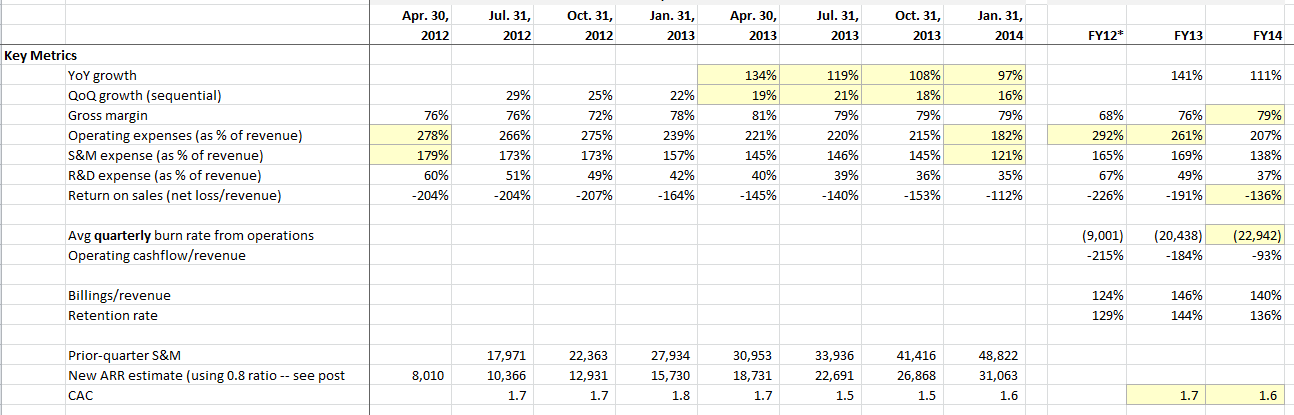
Here are some summarized key metrics (using yellow to highlight points of interest).

box key metrics

..

Of note:

  • Year over year growth, while high at 97% is slowly decelerating.
  • Gross margins are nice at nearly 80%
  • Operating expenses are massive:  278% of sales in 1Q12 down to “only” 182% in 4Q14.
  • S&M expense are a seemingly very high 121% of revenues.  This looks bad, but to really know what’s going on we need to examine the CAC, which looks pretty good.
  • Return on sales is -112%
  • That burn rate sure grabs you:  $22M per quarter

In many ways you see a typical “go big or go home” cloud computing firm, burning boatloads of cash but acquiring customers in a reasonably efficient manner and doing a nice job with retention/cross-sell/up-sell as judged by their retention numbers. When you look big picture, I believe they see themselves in a winner-take-all battle vs. DropBox and in this case, the strategy — while amazingly cash consumptive — does make sense.

Here is  a look at cashflow and billings:

box cashflow and billings

..

And last, but certainly not least, here is the P&L:

box p+l

..

Of note:

  • I’m always amazed  by the R&D spend of seemingly simple consumer services.  They spent $46M in R&D last year … on what?
  • The $171M in S&M expense sure grabs your attention
  • As does the $168M net loss!

Burn baby burn!

[Revised and expanded 3/27/14 9:18 AM]

# # #

I am not a financial analyst.  I do not make buy, sell, or hold recommendations on stocks.  See my FAQ for affiliations and disclaimers.

To Pre-Meet Or Not To Pre-Meet: That Is The Question

I once asked one of my board members which CEO ran the best board meetings across his portfolio companies.  His answer was, let’s call him, Jack.  Here’s what he said about him:

  • Jack got the board deck out 3-4 days in advance of the board meeting
  • Jack would call him — and every other board member — 2-3 days before each board meeting and walk through the entire deck and answer questions, taking maybe 2 hours to do so.
  • Board meetings with Jack would go very quickly and smoothly because all the questions had been asked in advance.

When I heard this, I thought, well, I have a few issues with Jack:

  • He spends a lot of time managing his board instead of running his business.  (I guess he got his CEO job by managing-up.)
  • He completely violates my “do it in the meeting” principle by having a series of pre-meetings before the actual meeting.

While I may have my doubts about Jack, others don’t seem to.  Consider entrepreneur and VC Mark Suster’s recent post, Why You Shouldn’t Decide Anything Important at Your Board Meetings.  Suster straight out recommends a 30 minute pre-meeting per board member.  Why?

  • Agenda input so you can adhere to the Golden Rule of Board Meetings:  “no surprises.”
  • So you can “count votes” in advance as know where people stand on important and/or controversial issues.
  • So you can use board members to convince each other of desired decisions.
  • Ultimately, because in his opinion, a board meeting is where you ratify decisions that are already pre-debated.

OK, I need to chew on this because, while practical, it violates every principle of how I think companies should conduct meetings — operational ones, at least.  When it comes to operational meetings, nothing makes me grumpier than:

  • Pre-meeting lobbying
  • Post-meeting “pocket vetoes”

My whole philosophy is that meetings should be the place where we debate things and make decisions.  Doing everything in advance defeats the purpose of meeting and risks encouraging political behavior (e.g., “if you vote for my bridge in Alaska, I’ll vote for your dam in Kentucky”), with managers horse-trading instead of voting for ideas based on their merits.

The only thing worse that teeing up everything in advance is what one old boss called the “pocket veto,” where a manager sits in a meeting, watches a decision get made, says nothing, and then goes to the CEO after the meeting and says something akin to “well, I didn’t feel comfortable saying this in the meeting, but based on point-I-was-uncomfortable-raising, I disagree strongly with the decision we reached.”

I remember this happened at Business Objects once and I thought:  “wait a minute, we’ve flown 15 people from around the world (in business class) to meet at this splendid hotel for 3 days — costing maybe literally $100,000 — and the group talked for two hours about a controversial decision, came to resolution, and made a decision only to have that decision overruled the next day.”  It made me wonder why we bothered to meet at all.

But I learned an important lesson.  Ever since then, I flat refuse to overrule decisions made in a meeting based on a pocket veto.  Whenever someone comes to me and says, “well, I didn’t feel comfortable bringing it up in the meeting (for some typically very good sounding reason about embarrassing someone or such), but based upon Thing-X, I think we need to reverse that decision,” I say one thing and only one thing in response:  “well, I guess you should have brought that up in the meeting.”

You see, I believe, based on a bevy of research, that functional groups of smart people make better decisions than even the smartest individuals.  So my job as CEO is to then assure three things:

But I’ve got a problem here because while we know that boards like pre-meetings, operationally I am opposed to both pre- and post-meetings.  Would it hypocritical for to say that pre-meetings are OK for me to conduct with the board, but that managers internally should avoid them?

Maybe.  But that’s what I’m going to say.   How can I sleep at night?  Because I think we need to differentiate between meetings with a decision maker  and meetings of a decision-making body.

Most people might think that the pricing committee, product strategy committee, or new product launch committee are democratic bodies, but they aren’t.  In reality, these are meetings with a decision maker present (e.g., the CEO, the SVP of products) and thus the committee is, perhaps subtly, an advisory group as opposed to a decision-making body.  In such meetings, the decision-maker should want to encourage vociferous debate, seek to prevent pre-meetings and horse-trading, and eliminate pocket vetoes because he/she wants to hear proposals debated clearly and completely based on the merits in order to arrive at the best decision.

However, board meetings are different.  Boards truly are a decision-making bodies ruled by one-person, one-vote.  Thus, while I reject Suster’s advice when it comes to conducting operational meetings (which I believe are inherently advisory groups), I agree with it when it comes to decision-making bodies.  In such cases, someone needs to know who stands where on what.

And that person needs to be the CEO.

The Old “Don’t Bring Up a Problem Unless You Have a Solution” Rule

There’s a rule out there, circulated widely as conventional wisdom, that you should never bring up a problem in the workplace unless you have a proposed solution.

For example, consider the following excerpt from this Inc. Magazine article, Eight Things Great Bosses Demand from Employees:

Rule 6:  Provide Solutions, Not Complaints.  Complainers are the bane of your boss’s existence. Nothing is more irritating or more boring than listening to somebody kvetch about things that they’re not willing to change.  So never bring up a problem unless you’ve got a solution to propose–or are willing to take the advice the boss gives you.

The argument goes that if you just bring up problems, then you’ll be seen as a whiner, as a complainer who drones on endlessly about problems that can’t be solved or that no one knows how to solve.

The question:  is this a good rule?

Let’s take an old example from my career.  It’s 1990, you work at Ingres which is $250M division of ASK, and you compete in the relational database market against Oracle, who is about $1B.  You are getting your ass kicked up and down by Oracle in the RDBMS market.  Management is silently executing a retreat strategy into the application development tools market and worse yet, your parent company, ASK, is betting all-in on a new version of Ingres 4GL that only works on the Ingres DBMS for their next-generation ERP system.

Here are some darn good problems:

  • Oracle is killing us in the DBMS market.
  • We are moving into tools when “runtimes” are increasingly free and there is no money to be made
  • We are double-downing on a proprietary, unstable application development environment instead of using standard tools
  • ASK is suffering from a serious escalation of commitment problem and should not double down on a dying database business.

If you followed the “don’t bring up a problem without a solution” rule then you could never talk about any of these problems.  And they are only the most important problems facing the company (and that would ultimately lead to its undoing).  What if, for example, you ran sales and had no idea what application development tools the company should be using, but simply knew which it should not?  Should you make up a bad solution just so you can talk about the problem?

I can take more recent examples of similar no-easy-solution problems:

  • What do we do about the Internet?  (At Business Objects in 1996, when we were 100% Windows client applications.)
  • What do we do about NoSQL?  (At MarkLogic in 2009 when we were a closed-source non-relational DBMS into a strong open-source trend.)
  • What do we do about Zendesk? (At Salesforce in 2012 after acquiring Assit.ly and mistakenly seeking synergy vs. trying to use it in a major blunting initiative.)

Let’s look beyond the business environment and see some problems that we couldn’t talk about if we followed the rule:

  • Mid-East peace
  • Cancer
  • Global warming

“Sorry Jimmy, if you don’t know the solution to global warming then you shouldn’t bring it up because you’ll just be whining.”

Obviously, I think it’s a stupid rule.

The correct rule is:  don’t whine.

It turns out the hardest problems, the most important problems, often have no obvious solution.  So if you prohibit discussing them, you cripple our organization and limit discussion only to easier, more tactical matters, akin to re-arranging the deck chairs on the Titanic.