The Customer Acquisition Cost (CAC) Ratio: Another Subtle SaaS Metric

The software-as-a-service (SaaS) space is full of seemingly simple metrics that can quickly slip through your fingers when you try to grasp them.  For example, see Measuring SaaS Renewals Rates:  Way More Than Meets the Eye for a two-thousand-word post examining the many possible answers to the seemingly simple question, “what’s your renewal rate?”

In this post, I’ll do a similar examination to the slightly simpler question, “what’s your customer acquisition cost (CAC) ratio?”

I write these posts, by the way, not because I revel in the detail of calculating SaaS / cloud metrics, but rather because I cannot stand when groups of otherwise very intelligent people have long discussions based on ill-defined metrics.  The first rule of metrics is to understand what they are and what they mean before entertaining long discussions and/or making important decisions about them.  Otherwise you’re just counting angels on pinheads.

The intent of the CAC ratio is to determine the cost associated with acquiring a customer in a subscription business.  When trying to calculate it, however, there are six key issues to consider:

  • Months vs. years
  • Customers vs. dollars
  • Revenue on top vs. bottom
  • Revenue vs. gross margin
  • The cost of customer success
  • Time periods of S&M

Months vs. Years

The first question — which relates not only to CAC but also to many other SaaS metrics:  is your business inherently monthly or annual?

Since the SaaS movement started out with monthly pricing and monthly payments, many SaaS businesses conceptualized themselves as monthly and thus many of the early SaaS metrics were defined in monthly terms (e.g., monthly recurring revenue, or MRR).

While for some businesses this undoubtedly remains true, for many others – particularly in the enterprise space – the real rhythm of the business is annual.  Salesforce.com, the enterprise SaaS pioneer, figured this out early on as customers actually encouraged the company to move to an annual rhythm, for among other reasons, to avoid the hassle associated with monthly billing.

Hence, many SaaS companies today view themselves as in the business of selling annual subscriptions and talk not about MRR, but ARR (annual recurring revenue).

Customers vs. Dollars

If you ask some cloud companies their CAC ratio, they will respond with a dollar figure – e.g., “it costs us $12,500 to acquire a customer.”  Technically speaking, I’d call this customer acquisition cost, and not a cost ratio.

There is nothing wrong with using customer acquisition cost as a metric and, in fact, the more your business is generally consistent and the more your customers resemble each other, the more logical it is to say things like, “our average customer costs $2,400 to acquire and pays us $400/month, so we recoup our customer acquisition cost in six months.”

However, I believe that in most SaaS businesses:

  • The company is trying to run a “velocity” and an “enterprise” model in parallel.
  • The company may also be trying to run a freemium model (e.g., with a free and/or a low-price individual subscription) as well.

Ergo, your typical SaaS company might be running three business models in parallel, so wherever possible, I’d argue that you want to segment your CAC (and other metric) analysis.

In so doing, I offer a few generic cautions:

  • Remember to avoid the easy mistake of taking “averages of averages,” which is incorrect because it does not reflect weighting the size of the various businesses.
  • Remember that in a bi-modal business that the average of the two real businesses represents a fictional mathematical middle.

avg of avg

For example, the “weighted avg” column above is mathematically correct, but it contains relatively little information.  In the same sense that you’ll never find a family with 1.8 children, you won’t find a customer with $12.7K in revenue/month.  The reality is not that the company’s average months to recoup CAC is a seemingly healthy 10.8 – the reality is the company has one very nice business (SMB) where it takes only 6 months to recoup CAC and one very expensive one where it takes 30.  How you address the 30-month CAC recovery is quite different from how you might try to squeeze a month or two out the 10.8.

Because customers come in so many different sizes, I dislike presenting CAC as an average cost to acquire a customer and prefer to define CAC as an average cost to acquire a dollar of annual recurring revenue.

Revenue on Top vs. Bottom

When I first encountered the CAC ratio is was in a Bessemer white paper, and it looked like this.

cac picture

In English, Bessemer defined the 3Q08 CAC as the annualized amount of incremental gross margin in 3Q08 divided by total S&M expense in 2Q08 (the prior quarter).

Let’s put aside (for a while) the choice to use gross margin as opposed to revenue (e.g., ARR) in the numerator.  Instead let’s focus on whether revenue makes more sense in the numerator or the denominator.  Should we think of the CAC ratio as:

  • The amount of S&M we spend to generate $1 of revenue
  • The amount of revenue we get per $1 of S&M cost

To me, Bessemer defined the ratio upside down.  The customer acquisition cost ratio should be the amount of S&M spent to acquire a dollar of (annual recurring) revenue.

Scale Venture Partners evidently agreed  and published a metric they called the Magic Number:

Take the change in subscription revenue between two quarters, annualize it (multiply by four), and divide the result by the sales and marketing spend for the earlier of the two quarters.

This changes the Bessemer CAC to use subscription revenue, not gross margin, as well as inverts it.  I think this is very close to CAC should be calculated.  See below for more.

Bessemer later (kind of) conceded the inversion — while they side-stepped redefining the CAC, per se, they now emphasize a new metric called “CAC payback period” which puts S&M in the numerator.

Revenue vs. Gross Margin

While Bessemer has written some great papers on Cloud Computing (including their Top Ten Laws of Cloud Computing and Thirty Q&A that Every SaaS Revenue Leader Needs to Know) I think they have a tendency to over-think things and try to extract too much from a single metric in defining their CAC.  For example, I think their choice to use gross margin, as opposed to ARR, is a mistake.

One metric should be focused on measuring one specific item. To measure the overall business, you should create a great set of metrics that work together to show the overall state of affairs.

leaky

I think of a SaaS company as a leaky bucket.  The existing water level is a company’s starting ARR.  During a time period the company adds water to the bucket in form of sales (new ARR), and water leaks out of the bucket in the form of churn.

  • If you want to know how efficient a company is at adding water to the bucket, look at the CAC ratio.
  • If you want to know what happens to water once in the bucket, look at the renewal rates.
  • If you want to know how efficiently a company runs its SaaS service, look at the subscription gross margins.

There is no need to blend the efficiency of operating the SaaS service with the efficiency of customer acquisition into a single metric.  First, they are driven by different levers.  Second, to do so invariably means that being good at one of them can mask being bad at the other.  You are far better off, in my opinion, looking at these three important efficiencies independently.

The Cost of Customer Success

Most SaaS companies have “customer success” departments that are distinct from their customer support departments (which are accounted for in COGS).  The mission of the customer success team is to maximize the renewals rate – i.e., to prevent water from leaking out of the bucket – and towards this end they typically offer a form of proactive support and adoption monitoring to ferret out problems early, fix them, and keep customers happy so they will renew their subscriptions.

In addition, the customer success team often handles basic upsell and cross-sell, selling customers additional seats or complementary products.  Typically, when a sale to an existing customer crosses some size or difficultly threshold, it will be kicked back to sales.  For this reason, I think of customer success as handling incidental upsell and cross-sell.

The question with respect to the CAC is what to do with the customer success team.  They are “sales” to the extent that they are renewing, upselling, and cross-selling customers.  However, they are primarily about ARR preservation as opposed to new ARR.

My preferred solution is to exclude both the results from and the cost of the customer success team in calculating the CAC.  That is, my definition of the CAC is:

dk cac pic

I explicitly exclude the cost customer success in the numerator and exclude the effects of churn in the denominator by looking only at the new ARR added during the quarter.  This formula works on the assumption that the customer success team is selling a relatively immaterial amount of new ARR (and that their primary mission instead is ARR preservation).  If that is not true, then you will need to exclude both the new ARR from customer success as well as its cost.

I like this formula because it keeps you focused on what the ratio is called:  customer acquisition cost.  We use revenue instead of gross margin and we exclude the cost of customer success because we are trying to build a ratio to examine one thing:  how efficiently do I add new ARR to the bucket?  My CAC deliberately says nothing about:

  • What happens to the water once S&M pours it in the bucket.  A company might be tremendous at acquiring customers, but terrible at keeping them (e.g., offer a poor quality service).  If you look at net change in ARR across two periods then you are including both the effects of new sales and churn.  That is why I look only at new ARR.
  • The profitability of operating the service.  A company might be great at acquiring customers but unable to operate its service at a profit.  You can see that easily in subscription gross margins and don’t need to embed that in the CAC.

There is a problem, of course.  For public companies you will not be able to calculate my CAC because in all likelihood customer success has been included in S&M expense but not broken out and because you can typically only determine the net change in subscription revenues and not the amounts of new ARR and churn.  Hence, for public companies, the Magic Number is probably your best metric, but I’d just call it 1/CAC.

My definition is pretty close to that used by Pacific Crest in their annual survey, which uses yet another slightly different definition of the CAC:  how much do you spend in S&M for a dollar of annual contract value (ACV) from a new customer?

(Note that many vendors include first-year professional services in their definition of ACV which is why I prefer ARR.  Pacific Crest, however, defines ACV so it is equivalent to ARR.)

I think Pacific Crest’s definition has very much the same spirit as my own.  I am, by comparison, deliberately simpler (and sloppier) in assuming that customer success not providing a lot of new ARR (which is not to say that a company is not making significant sales to its customer base – but is to say that those opportunities are handed back to the sales function.)

Let’s see the distribution of CAC ratios reported in Pacific Crest’s recent, wonderful survey:
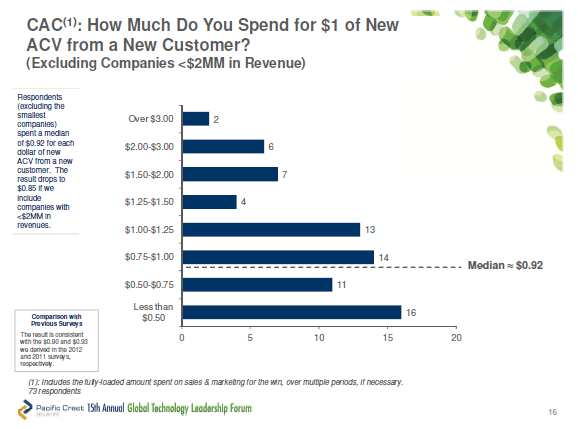
pac crest cac

Wow.  It seems like a whole lot of math and analysis to come back and say:  “the answer is 1.

But that’s what it is.  A healthy CAC ratio is around 1, which means that a company’s S&M investment in acquiring a new customer is repaid in about a year.  Given COGS associated with running the service and a company’s operating expenses, this implies that the company is not making money until at least year 3.  This is why higher CACs are undesirable and why SaaS businesses care so much about renewals.

Technically speaking, there is no absolute “right” answer to the CAC question in my mind.  Ultimately the amount you spend on anything should be related to what it’s worth, which means we need relate customer acquisition cost to customer lifetime value (LTV).

For example, a company whose typical customer lifetime is 3 years needs to have a CAC well less than 1, whereas a company with a 10 year typical customer lifetime can probably afford a CAC of more than 2.  (The NPV of a 10-year subscription increasing price at 3% with a 90% renewal rate and discount at 8% is nearly $7.)

Time Periods of S&M Expense

Let me end by taking a practical position on what could be a huge rat-hole if examined from first principles.  The one part of the CAC we’ve not yet challenged is the use of the prior quarter’s sales and marketing expense.  That basically assumes a 90-day sales cycle – i.e., that total S&M expense from the prior quarter is what creates ARR in the current quarter.  In most enterprise SaaS companies this isn’t true.  Customers may engage with a vendor over a period of a year before signing up.  Rather than creating some overlapped ramp to try and better model how S&M expense turns into ARR, I generally recommend simply using the prior quarter for two reasons:

  • Some blind faith in offsetting errors theory.  (e.g., if 10% of this quarter’s S&M won’t benefit us for a year than 10% of a year ago’s spend did the same thing, so unless we are growing very quickly this will sort of cancel out).
  • Comparability.  Regardless of its fundamental correctness, you will have nothing to compare to if you create your own “more accurate” ramp.

I hope you’ve enjoyed this journey of CAC discovery.  Please let me know if you have questions or comments.

Thoughts on MongoDB’s Humongous $150M Round

Two weeks ago MongoDB, formerly known as 10gen, announced a massive $150M funding round said to be the largest in the history of databases lead by Fidelity, Altimeter, and Salesforce.com with participation from existing investors Intel, NEA, Red Hat, and Sequoia.  This brings the total capital raised by MongoDB to $231M, making it the best-funded database / big data technology of all time.

What does this mean?

The two winners of the next-generation NoSQL database wars have been decided:  MongoDB and Hadoop.  The faster the runner-ups  figure that out, the faster they can carve off sensible niches on the periphery of the market instead of running like decapitated chickens in the middle. [1]

The first reason I say this is because of the increasing returns (or, network effects) in platform markets.  These effects are weak to non-existent in applications markets, but in core platform markets like databases, the rich invariably get richer.  Why?

  • The more people that use a database, the easier it is to find people to staff teams so the more likely you are to use it.
  • The more people that use a database, the richer the community of people you can leverage to get help
  • The more people that build applications atop a database, the less perceived risk there is in building a new application atop it.
  • The more people that use a database, the more jobs there are around it, which attracts more people to learn how to use it.
  • The more people that use a database, the cooler it is seen to be which in turn attracts more people to want to learn it.
  • The more people that use a database, the more likely major universities are to teach how to use it in their computer science departments.

To see just how strong MongoDB has become in this regard, see here.  My favorite analysis is the 451 Groups’ LinkedIn NoSQL skills analysis, below.

linkedinq31

This is why betting on horizontal underdogs in core platform markets is rarely a good idea.  At some point, best technology or not, a strong leader becomes the universal safe choice.  Consider 1990 to about 2005 where the relational model was the chosen technology and the market a comfortable oligopoly ruled by Oracle, IBM, and Microsoft.

It’s taken 30+ years (and numerous prior failed attempts) to create a credible threat to the relational stasis, but the combination of three forces is proving to be a perfect storm:

  • Open source business models which cut costs by a factor of 10
  • Increasing amounts of data in unstructured data types which do not map well to the relational model.
  • A change in hardware topology to from fewer/bigger computers to vast numbers of smaller ones.

While all technologies die slowly, the best days of relational databases are now clearly behind them.  Kids graduating college today see SQL the way I saw COBOL when I graduated from Berkeley in 1985.  Yes, COBOL was everywhere.  Yes, you could easily get a job programming it.  But it was not cool in any way whatsoever and it certainly was not the future.  It was more of a “trade school” language than interesting computer science.

The second reason I say this is because of my experience at Ingres, one of the original relational database providers which — despite growing from ~$30M to ~$250M during my tenure from 1985 to 1992 — never realized that it had lost the market and needed a plan B strategy.  In Ingres’s case (and with full 20/20 hindsight) there was a very viable plan B available:  as the leader in query optimization, Ingres could have easily focused exclusively on data warehousing at its dawn and become the leader in that segment as opposed to a loser in the overall market.  Yet, executives too often deny market reality, preferring to die in the name of “going big” as opposed to living (and prospering) in what could be seen as “going home.”  Runner-up vendors should think hard about the lessons of Ingres.

The last reason I say this is because of what I see as a change in venture capital. In the 1980s and 1990s VCs used to fund categories and cage-fights.  A new category would be identified, 5-10 companies would get created around it, each might raise $20-$30M in venture capital and then there would be one heck of a cage-fight for market leadership.

Today that seems less true.  VCs seem to prefer funding companies to categories.  (Does anyone know what category Box is in?  Does anyone care about any other vendor in it?)  Today, it seems that VCs fund fewer players, create fewer cage-fights, and prefer to invest much more, much later in a company that appears to be a clear winner.

This, so-called “momentum investing” itself helps to anoint winners because if Box can raise $309M, then it doesn’t really matter how smart the folks at WatchDox are or how clever their technology.

MongoDB is in this enviable position in the next-generation (open source) NoSQL database market.  It has built a huge following, that huge following is attracting a huge-r (sorry) following.  That cycle is attracting momentum investors who see MongoDB as the clear leader.  Those investors give MongoDB $150M.

By my math, if entirely invested in sales [2], that money could fund hiring some 500 sales teams who could generate maybe $400M a year in incremental revenue.  Which would in turn will attract more users.  Which would make the community bigger.  Which would de-risk using the system.  Which would attract more users.

And, quoting Vonnegut, so it goes.

# # #

Disclaimer:  I own shares in several of the companies mentioned herein as well as competitors who are not.  See my FAQ for more.

[1] Because I try to avoid writing about MarkLogic, I should be clear that while one can (and I have) argued that MarkLogic is a NoSQL system, my thinking has evolved over time and I now put much more weight on the open-source test as described in the “perfect storm” paragraph above.  Ergo, for the purposes of this post, I exclude MarkLogic entirely from the analysis because they are not in the open-source NoSQL market (despite the 451’s including them in their skills index).  Regarding MarkLogic, I have no public opinion and I do not view MongoDB’s or Hadoop’s success as definitively meaning either anything either good or bad for them.

[2] Which, by the way, they have explicitly said they will not do.  They have said, “the company will use these funds to further invest in the core MongoDB project as well as in MongoDB Management Service, a suite of tools and services to operate MongoDB at scale. In addition, MongoDB will extend its efforts in supporting its growing user base throughout the world.”

Measuring SaaS Renewal Rates: Way More Than Meets the Eye

****

Please note that this post has been superseded by A Fresh Look at How to Measure SaaS Churn Rates.  I’m leaving it posted to protect in-bound links and because I think it’s still worth reading, but if you want my latest thoughts on how to calculate these rates, see the above post. 

****

I love cloud computing. I love metrics. And I love renewals. So when I went looking on the Web for a great discussion of SaaS renewals and metrics I was surprised not to find much. Certainly, I found the two classics on SaaS metrics:

  • The Bessemer Venture Partners 10 Laws of Cloud Computing white paper, which I highly recommend despite its increasing pollution with portfolio-company marketing.

The Four Factors
While the above articles are all great, I was surprised that no one really dug into the nitty-gritty of renewals at an enterprise SaaS company, where I believe there are four independent factors at work:

  • Timing. When a contracted is renewed. For example, how to handle when a contract is renewed early or late.
  • Duration. The length of the renewed contract. For example, how to handle when a one-year customer renews for three years, and receives a multi-year discount in the process (for either pre-payment or the contractual commitment itself). [1]
  • Expansion/shrinkage. The expansion or shrinkage of the contract’s value compared to the original contract. For example, how to handle customers adding or dropping seats or products, and/or price increases or decreases.
  • The count metric. What do we wish to count (e.g., bookings, ARR, seats, or customers) and what does it mean when we count one thing versus another.

Particularly in a world where companies are increasingly marketing “negative churn” rates and renewal rates well in excess of 100%, I think it’s worth digging into this and offering some rigor.

A Simple Example
Let’s take a concrete example. Imagine a customer who buys 100 seats of product A at $1,200/seat/year on 7/30/12, with a contractual provision that says the price cannot increase by more than 3% per year [1a].

Imagine that customer renews on 6/30/13, buying 80 seats of product A for $1,225, and adding 40 seats of product B at $1,200/seat/year, and who receives a 15% discount for making a prepaid three-year commitment.

Hang on. While I know you want to run away right now, don’t. This is all real-life stuff in a SaaS company. Bear with me, and download the spreadsheet here (as an Excel file, not a PDF) that shows the supporting math.

A few questions are easy:

  • What were the bookings on the initial order? Answer: $120,000.
  • What was the annual recurring revenue (ARR) of the initial order? Answer: $120,000.
  • What were the bookings on the renewal order? Answer: $372,300.
  • What was the ARR of the renewal order? Answer: $124,100. [2]

Calculating Churn: Leaky Bucket Analysis
So far, so good. Now let’s talk about churn. Because, as you will see, renewal rates alone are complicated enough, I have adopted a convention where:

  • When it comes to renewals, I look only at rates
  • When it comes to churn, I look only at dollars/values

I know this is a completely arbitrary decision, but doing this lets me remember one set of formulas instead of two, reduces rat-hole conversations about definitions, and — most importantly – lets me look at one area in percentages and the other in dollars, helping me to avoid the “percent trap” where you can lose all perspective of absolute scale. [3]

I define churn with an equation that I call “leaky bucket analysis.” [4]

Starting ARR + new ARR – churn ARR = ending ARR

So, some questions:

  • Was there any churn associated with this renewal? Answer: Yes.
  • Why? Answer: Despite a small price increase on product A, there was a 15% multi-year discount and a loss of 20 seats which more than offset it.
  • How much ARR churned? Answer: $36,700. [5]
  • How much new ARR was added? Answer: $40,800. The after-discount value of the product B subscriptions.
  • What is ending ARR? 124,100 = 120,000 + 40,800 – 36,700.
  • How many customers churned? Answer: 0.
  • How many seats churned? Answer: 20.

Note that ARR, seats, and customers are all snapshot (or, point-in-time) metrics that lend themselves to leaky bucket analysis. Period-metrics, like bookings, do not. Bookings happen within a period. There is no concept of starting bookings + new bookings – churn bookings = ending bookings. That’s not how it works. So, when you define churn through leaky bucket analysis, measuring bookings churn doesn’t work.

We can, however, calculate bookings churn as the difference between what was up for renewal and what we renewed. In this case, $120,000 – $372,300 = ($252,300), showing one way to generate a negative churn number. The example makes somewhat more sense in the other direction: if we had a three-year $372,300 contract up for renewal and only renewed $120,000 them we might argue that $252,300 in bookings were churned. From a cash collections perspective, this makes sense [6].

But from a customer value perspective it does not. Unless the customer has plans to discontinue using the service, by dropping from a three-year to a one-year contract we will actually collect more money from them over the next 3 years if they continue to renew ($438,000 vs. $372,300) [7]. So the bookings churn that looks bad for year-one cash actually results in superior ARR and three-year cash collections.

The lesson here is that different metrics are suited for measuring different things. In this case, we can see that bookings churn is useful primarily for analyzing short-term cash collections and not, say, for customer lifetime value or customer satisfaction.

Renewal Rates and Timing
Now that we’re warmed up let’s have some fun. Let’s answer some questions on renewals:

  • From a bookings perspective, when should we count the renewal order? Answer: the order was received on 6/30/13 so it’s a 2Q13 booking.
  • From a renewal rate perspective, when should we count this order? Answer: while debatable, to me it’s a renewal of a 3Q contract, so I would count it in 3Q from a renewal rate perspective. [8]
  • When would we count the booking if it were late and arrived on 10/30/13? Answer: From a bookings perspective, it would be a 4Q13 booking. From a renewal rate perspective, it’s the renewal of a 3Q contract, so I would count it in 3Q. [9]
  • On a customer-count basis, how do we count this renewal? Answer: 100%. We had one logo before and we have one logo after, so 100%. [10]

Here it’s going to get a little dicey.

On an ARR basis, how do we measure this renewal? Answer: this begs the question of whether we should include expansion ARR due to new seats, new products, and price increases. Since I am worried that expansion may hide shrinkage, I want to see this both ways. Hence, I will define “gross” to mean including expansion and “net” to mean excluding expansion.

  • What is the gross ARR-based renewal rate? Answer: 103%. [11]
  • What is the net ARR-based renewal rate? Answer: 69%. Now you understand why I want to see it both ways. The net rate is showing that we lost real ARR on product A due to reduced seats and the multi-year discount. The upsell of product B hides shrinkage, producing an innocuous 103% number that might evoke a very different scenario in the mind’s eye (e.g., renewing the original deal for one year with a 3% price hike).
  • What is the gross bookings-based renewal rate? Answer: 310%. We took a $120,000 order and renewed it at $372,000. (But we transformed it greatly in the process.)
  • What is the net bookings-based renewal rate? 208%. We took a $120,000 order for product A and turned it into a $249,000 order for product A. But we dropped ARR about 33% in the process (from $120,000 to $83,300) through lost seats and the multi-year discount.
  • What is the gross seat-count renewal rate? 120%
  • What is the net seat-count renewal rate? 80%
  • What is the customer-count renewal rate? 100%

Identifying the Best Renewal-Related Metrics
So, what is the renewal rate then anyway?  69%, 80%, 100%, 103%, 120%, 208%, or 310%?

I’d say the answer depends on what you want to measure. Having nearly drowned you in the renewal-rate swamp, let me now drain it. Here are the metrics that I think matter most:

key renewals metrics

Here’s why:

  • Leaky bucket analysis is important because ARR growth is the single most important driver of value for a SaaS company.
  • Churn ARR shows you, viscerally, how much extra you had to sell just to make up for leaks [12].  Rates seem sterile by comparison.
  • The customer count-based renewal rate is the best indicator of overall customer satisfaction: what percent of your customers want to keep doing business with you, regardless of whether they change their configuration, product mix, seat mix, contract duration, etc.
  • The gross seat-based based renewal rate shows you how effective you are at driving adoption of your services. Think: land and expand (in terms of seats).
  • The gross ARR-based renewal rate shows you, overall, how effective you are at increasing your customers’ annual commitment. However, it says nothing about how you do that (i.e., which type of expansion ARR) or the extent to which expansion ARR in one area is offsetting shrinkage in another.
  • The net ARR-based renewal rate shows you how much of ARR you renew without relying on expansion. This is a very conservative metric designed to unmask problems that can be hidden by expansion ARR.
  • The gross bookings-based renewal rate is the best predictor of future cashflows. If we know that, on average, we take an order of 100 units and turn it into an order of 175 units – through whatever means – then we should use this metric to predict cashflows. Note that, as we’ve seen, there are trade-offs between ARR and bookings, but the consequences of those can be revealed by other metrics.

Revision 6/25/14, New Definition of Simple Churn, Timing Issues on Gross ARR Renewal Rate
While I generally like and stick with my “show churn in dollars and renewal rates in percents” mentality, I have found that a lot of people still ask about churn as a rate.

To answer, I use one of two different metrics:

  • “Simple churn” which = (net change in ARR from existing customers  / starting-period-ARR) * 4.  This is, I believe, what most companies present as their churn rate, includes the effects of both shrinkage and expansion ARR, and is arguably optimistic because it implicitly includes multi-year deals in the starting ARR.
  • “Simple net churn” which = (churn ARR / starting-period-ARR) * 4.  This presents churn net-of (i.e., exclusive of) expansion ARR.

I have discovered that there are timing issues with the gross ARR renewal rate, defined above.  For companies that do multi-year deals, you will end up including expansion ARR in your ARR base as it is sold along the way, but only reflecting it in the renewal rate when the contract renews, in effect deferring good news until renewal time, and seemingly failing to take credit along the way.

Footnotes
[1] Note that in a multi-year prepaid contract that bookings (order value) equals total contract value (TCV). When multi-year contracts are not prepaid, bookings are only the first-year portion of TCV.

[1a] Some purists would argue that having the right to raise the price 3% should set the denominator of subsequent renewal rate calculations to 1.03 * original-value.  While I get the idea, I nevertheless disagree.

[2] The renewal order is for three years, so to calculate the ARR we need to divide the bookings value by three.

[3] Saying our “churn rate was 10%” makes things sound OK, but saying we churned $2M in ARR is, to me, somehow more visceral. That is, we had to sell an extra $2M in ARR just to make up for existing business that we lost.

[4] A leaky bucket starts at one water level, during a period new water is added, some water leaks out, and the net change establish the ending water level. (Note that in leaky bucket analysis, definitionally, leaks are never negative.)

[5] Now might be a good time to download the spreadsheet accompanying this post so you can see my calculations. In this case, the churn is the difference between the total value from product A on the original order versus the renewals order.

[6] Subscription bookings typically turn into cash within 90 days.

[7] In reality, we should both uplift the price in years 2 and 3 and discount by the renewal rate to get a better expected cash collections figure. (There is nearly endless detail in analyzing this subject but I will make simplifying assumptions at times.)

[8] Otherwise, it would juice 2Q renewal rates and depress 3Q renewal rates, making both less meaningful.

[9] Bonus question:  how would you handle the late-renewal scenario at the 7/20/13 board meeting? Answer: I would publish provisional renewal rates that exclude the transaction, letting the board know we have an outstanding renewal in process. Then once it closed, I would revise the 3Q renewal rates accordingly.

[10] Which then begs the question of how you count customers. For example, while GE has one logo, they have numerous very independent divisions in a large number of countries.

[11] Note that purist might argue that since we had the right to raise prices up to 3% that we should put 103% of the ARR in denominator in this and all similar calculations, thus dropping the resulting renewal rate here to 100%.  While I believe annual increases are important, I still believe renewing someone to 103K in ARR who was at 100K in ARR is a 103% renewal.  Tab 3 of the supporting spreadsheet plays with some numbers in this regard.

[12] It is a good idea to divide churn into 3 buckets to describe the reason: owner change (including bankruptcy), leadership change, and customer dissatisfaction.

5 Things Executives Should Say More About The Budget

I’m always struck by how often good business ideas, conceived with the best of intentions, get flipped upside-down when applied by some managers.  A favorite example is the 3x pipeline rule about which I’ve already blogged (see The Self-Fulfilling 3x Pipeline Coverage Fallacy).  Another might be the 50 calls/day rule for an SDR or a 100 lead goal for a marketing event.

Instead of using tools and metrics to intelligently guide us, we all too often become slaves to them.  We get 3x pipeline coverage because sales management will scream if we don’t.  We make 50 calls/day — even if they’re all “left voicemail” — because everyone else does.  We generate 100 leads, regardless of their quality, because that’s what the boss wanted.

As we approach annual planning season, I thought I’d take a moment to post on the corporate budget — a useful tool if there ever was one, but one all too often used as an instrument of oppression, rather than one of empowerment.

I won’t go into an analysis of the major problems in producing corporate budgets both because I’ve already done so (see The Great Dysfunctional Corporate Budgeting Process) and because the Wall Street Journal also recently featured an excellent op-ed piece describing the key problems (see Companies Get Budgets All Wrong).

Instead of talking about problems with the budget creation process, today I’m going to focus today on how executives communicate to their teams about budgets and budget-related issues.

All too often managers de-power themselves by saying things like:

  • “I know we’re dying for resource here in technical support and trust me, I’m fighting as hard I can for you, but ‘Dr. No the CFO’ just won’t give us any more resources.  I know it stinks, and that maybe it means we really don’t care about our customers, but perhaps next year it will get better and your job will suck less.”
  • “I’m sorry — that’s a great idea, but we just don’t have the budget for it.”
  • “I’d love to hire that amazing person, but they cost 108% of what we budgeted.   Go hire someone within budget.”
  • “Gosh, $15,000 for an experimental marketing program is a lot of money that we don’t have budgeted.  Let’s not try it.”

I’ve heard all of these statements myself, multiple times, in real life as I worked my way up the corporate ladder.  Each of them is a cop-out where the manager fails to show leadership, positions himself as a victim, de-powers himself in front of his team, and demotivates his team in the process.

I expect my executive team members to stay within budget (unless I’ve given them explicit approval otherwise) but it’s also very important to me that they not cop out and act like a prisoner of the budget, instead of its master, in so doing.

To make this philosophy actionable, I have come up with five things executives should say more when talking to their teams about the budget:

  • “We need to spend what we have before we gripe about needing more.”
  • “Show me a rockstar and I’ll hire them.”
  • “I always have $50K for a great idea.”
  • “$15K is a rounding error in my budget.”
  • “Great things often start with small investments.”

“We need to spend what we have before we gripe about needing more.”
The fast-track way out of most executive jobs is to give an impassioned speech to the operating committee about how much your team is struggling under an undue workload, how close everyone is to the breaking point, and how unsustainable the current situation is, only to have the following dialog ensue:

CEO: “I understand that calls per agent are up 30%. I understand that we struggling to hit our SLA targets. I understand the team is working hard. What I don’t understand is why you are making this speech. You are tracking to spend only 85% of your budget this quarter and have four open headcount.”

I saw this happen once in a management committee meeting. The speech was touching. The passion was real. But the logic was threadbare. The new head of customer service did not make a similar speech at the next meeting.

Executives need own their budgets both in the sense of not exceeding them, but also in the sense of spending them. The company has allocated resources to solve a problem. It is the executive’s job to deploy those resources. Particularly in high-growth companies, spending too little can be worse than spending too much.

Executives should also be transparent with their teams. If the team is behind on hiring, executives shouldn’t pretend that Darth CFO is the problem. “We’re the problem. So let’s go fix it.”

In the event the budget is fully deployed, executives still shouldn’t cop out. Instead of saying, “we’ve spent all that corporate gave us, and we’re still dying,” they need to reframe the situation as a challenge. “Either we need to find a way to meet the caseload with our current resources,” or “we need to do a better job at building a business case that convinces the company to give us more resources.”

We’re not victims. We either have an efficiency challenge or a better business case to make.

“Show me a rockstar and I’ll hire them.”
Hiring generates its own challenges. Headcount may open and close with the ups and downs of the sales forecast. At some companies, HR will foolishly not support a recruiting process 2-3 months before a headcount opens, thus building-in automatic delays. Sometimes we find people who cost more than what we’ve allocated in the budget.

Here is what I tell my team:

“I need to admit that I have a huge soft spot for talent. Show me a rockstar and I’ll hire them: budget-schmudget, headcount-schmedcount. We need to build a top-quality organization and I know that top-quality people don’t always come along at exactly the time and at exactly the cost that we have in our budget. So abuse me. Exploit my weakness. When it comes to talent, paraphrasing Rogers and Hammerstein, ‘I’m just a CEO who cain’t say no.’”

Why do I do this? First because it eliminates all possible excuses to not hiring great talent and second because I honestly believe it. Suppress your inner bureaucrat and don’t say “gosh, that guy’s a little too expensive” or “I think we’re going to have a headcount freeze, so let’s slow down on this one.”

Instead think: if after I hire this rockstar, if things got tight financially and I had to eliminate someone else to do so, would I? If the answer is yes, make the hire. Sports teams get stronger by recruiting players stronger the current line-up. Unlike sports, however, business isn’t zero-sum. We can take all the great players we can find. Once in a while if that means having to zero-sum things when the budget gets tight, so be it.

One convenient side-effect of this policy is that it lets you see who your executives think are rockstars. If someone uses the rockstar argument on me and the person in question is a dud, I’ve learned important information about my executive’s talent identification skills.

“I always have $50K for a great idea.”
I starting using this when I got my first marketing management job because I was so tired of hearing my bosses say, “that’s a great idea, too bad we can’t afford it.”

Let’s think for a second:

  • Either something is a great idea and management should figure out how to do it.
  • Or it’s not a great idea and management should tell its originator why.

But, please, don’t cop out and say, “it’s a great idea, but we can’t afford it.”

To flip this problem around I long ago adopted, “I always have $10K for a good idea” which I’ve title- and inflation-adjusted to $50K. Obviously, the number should scale according to your budget, but the point is first that you change your own reaction to new ideas and second that you don’t kill them at birth with, “before you tell me this, you should know I don’t have any money — so what’s your idea again?”

Instead say, “you’ve got an idea — let’s hear it — I always have $50K for a great idea.”

By the way, budgeting for this is highly recommended. I usually carry a cushion of 1-3x my “nut” each quarter to be sure that I can back up my words.

“$15K is a rounding error in my budget.”
Managers can get so focused on not exceeding budgets that I’ve literally been in meetings where people with $3M quarterly budgets take valuable executive team meeting time talking about $15K items. $15K is one-half of one-percent of a $3M budget. So, yes, while $15K is a lot of money and while money should never be wasted, I think executives need to remember what their 0.005 threshold is and remind their teams about it.

I don’t want to talk about items that either rounding errors or, more amazingly, completely invisible when rolled into the final quarterly numbers. Let’s, shall we, worry about the other 99.5% of our expenses?

The other way to say this is that executives should look holistically at their budgets. An excess focus on incremental expenses (often combined with a lack of planned cushion) is what leads people to lengthy discussions of rounding errors.

“Great things often start with small investments.”
A side effect of working at successful companies is that they grow. Teams get big. We have 100 engineers here and 200 engineers there. We’re spending $1M on this marketing event or that. People starting anchoring their idea of size relative to the core teams or programs that drive the company.

In so doing, they forget the critical principle that great ideas often start with small investments. Business Objects, which eventually sold for nearly $7B, was created on only $4M in venture capital. The entire Salesforce Social Enterprise vision, which helped catapult the company from $2B to $3B in revenues, was created on the back of a $70K outsourced Twitter connector, conceived by the amazing Service Cloud team.

Instead of starting with, “we need millions of dollars to build Chatter, integrate a feed-based paradigm into our entire CRM suite, and then become the social enterprise company,” the Service Cloud team started small. They said, “I bet companies would love to be able to find unhappy customers on Twitter, automatically create cases in response, and leverage their entire contact center infrastructure to provide support on social channels.”

They hired an outsourcer to build a Twitter connector, cases began flowing in, and the seeds of the Social Enterprise vision were born.

The moral of all this, of course, is that great ideas can start small. Instead of saying, “sorry, we can’t find $2M to fund your new idea,” executives needs to say, “how you can re-cast your idea to start small, so we can try it quickly, see if works, and then build from there?”

Sometimes it’s not possible. You can’t build a nuclear submarine or a 787 on incremental budget. But in information technology and consumer services, you can go a long way by starting small with a little money.

Sales is from Mars and Engineering is from Venus

I was talking to a startup CEO the other day and he said:

Lately my VP of Sales and my VP of  Engineering have been at each other’s throats.  Badly.  I need to write a book called Sales is From Mars, Engineering is From Venus or such.   Any ideas for me on how to manage this conflict?

Sure.  Two things typically go wrong in this relationship.  One is that you have a strategic alignment problem.  The other is that you’re treating sales and engineering the same way and — to your point — they are different animals and should be treated differently.

First, you must get this conflict back in control because it sounds dysfunctional, is hurting your organization, and to paraphrase Machiavelli, warring Princes means a weak King.  Since you’re the King, you need to end this war, posthaste.

The Strategic Problem with Sales and Engineering:  Alignment

Sales/Engineering tension typically comes from a lack of alignment around strategy.  Sales, by default, wants to sell anything to anybody and it’s up to the CEO to make sure that sales is ring-fenced enough into a target market that they can’t keep generating effectively random product requirements and be taken seriously.

Towards that end, you should create — as an executive team — a one-page document entitled “Our Target Market” that describes, using terse bullets, what the perfect prospect looks like when he or she walks through the door.

The more a given customer looks like that ideal, the more their voice should be heard in the product requirements process.  And conversely.  This helps create the notion of strategic vs. opportunistic revenue.  The former is revenue coming from the target, the latter is revenue that you will take, but you will not modify your product or strategy for it.

I have seen terrible battles between Sales and Engineering and this lack of alignment, and the long-list of fairly random product “deficiencies” that accompany it, is usually the cause.

Avoid the blame game.  Your e-staff is one team and you win or lose together.  If they’re fighting, it’s either because they’re bad folks and need replacement or they’re good folks and they are not aligned on the mission.

The Communication Problem with Sales and Engineering

Founder / technical CEOs love to reason.  They are reluctant to bark orders.  Instead they prefer to lay out options and debate merits, eventually arising at consensus around a strategy.  Logically and dispassionately.

That style tends to work well with Engineers (and marketers).  It tends to work far less well with Sales.  At the same time you might be thinking, “Gosh, I’m doing such a great job reasoning with my sales VP,” he or she is probably thinking “when is this clown going to make a stinking decision and tell me the answer?”

Sales are soldiers.  They like to be told to take hills and they will fight hard to do so.  They trust that you have chosen the right hill to take. They see you as the General leading the army.  They want you to do your job and they will do theirs.

My advice with Sales is to stop reasoning with them.  Explain quickly why you are sending them on the mission.  But don’t reason forever.  Make calls decisively and give the order that they are awaiting.  They will see you as a stronger leader and respect you for such.

Net/net:

  • Reason with Engineering
  • Command Sales

It may sound harsh, but in the end, I am certain that if you fix these two issues your Sales/Engineering conflict with disappear.